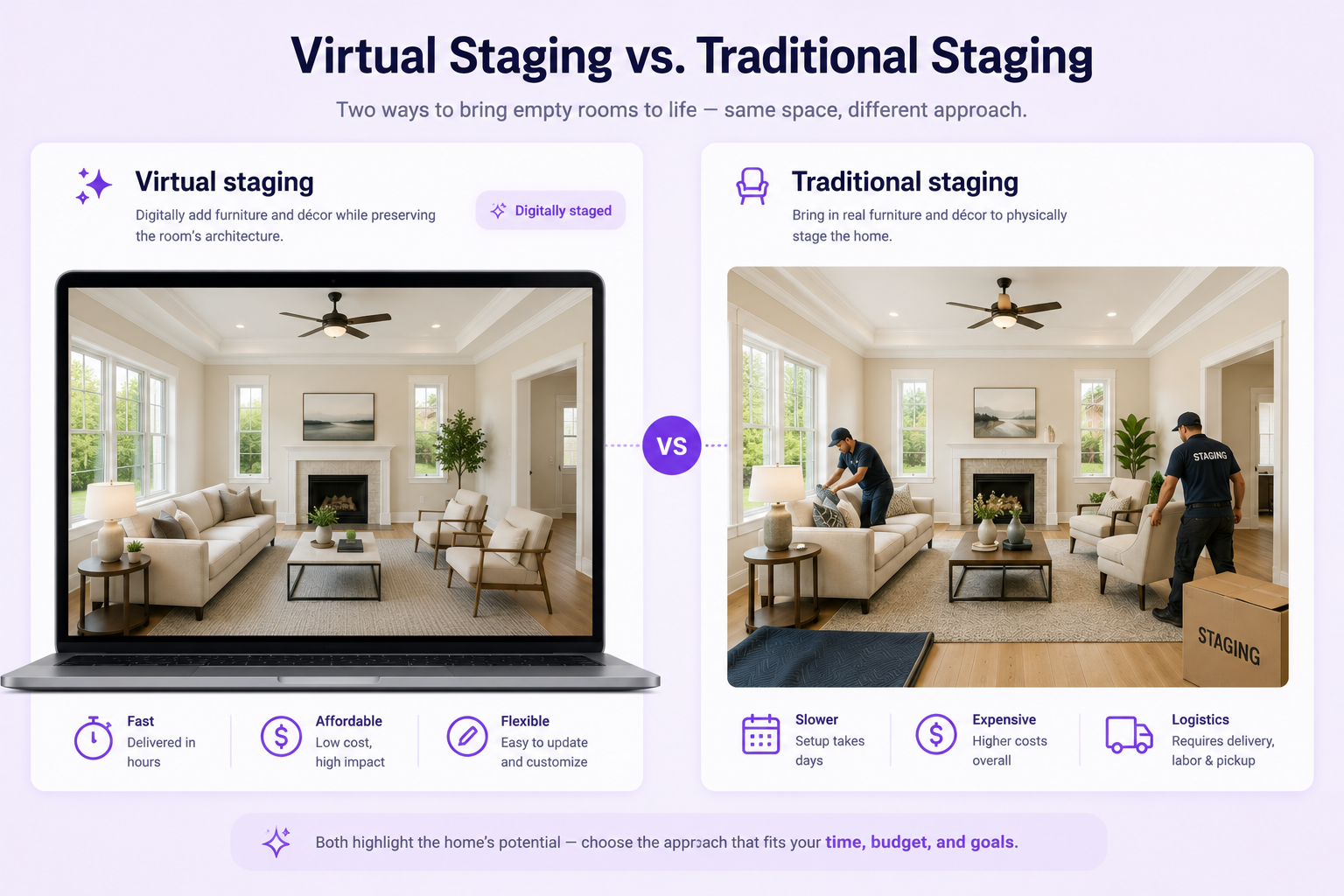
Staging helps potential buyers or renters understand how a property could look and function when furnished. The two main approaches are virtual staging, which adds furniture to listing photos digitally, and traditional staging, which places real furniture and decor inside the property.
Both methods can improve presentation, but they solve different problems. Virtual staging primarily improves online marketing. Traditional staging changes the experience of the actual property for photography, showings, and open houses.
The right option depends on the property, budget, timeline, market, buyer behavior, condition of the rooms, and whether the home will receive in-person visits.
This guide compares virtual staging vs. traditional staging across cost, speed, flexibility, realism, buyer experience, disclosure, vacant and occupied properties, and the situations where combining both methods may be useful.
What Is Virtual Staging?
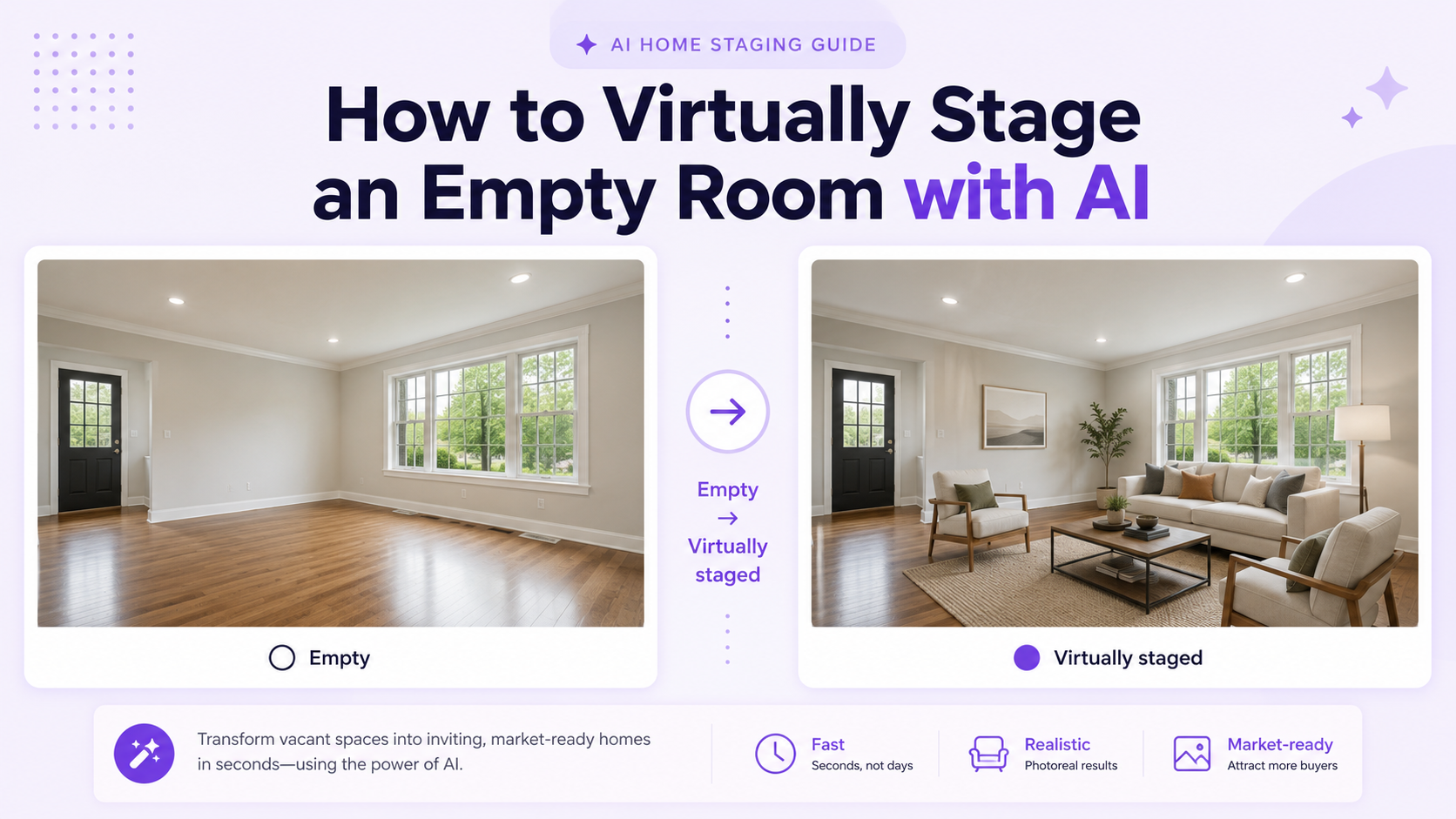
Virtual staging digitally adds furniture, rugs, lighting, artwork, plants, and decor to a real photograph of a room. The physical property remains unchanged.
The work may be created with manual photo compositing, 3D rendering, generative AI, image-to-image editing, or a combination of techniques.
Virtual staging is mainly used to make empty or lightly furnished rooms easier to understand in online listings, social posts, advertisements, and brochures.
What Is Traditional Staging?
Traditional staging physically prepares the property using real furniture, decor, textiles, lighting, artwork, and accessories.
The process may involve rearranging the owner’s belongings, renting furniture, removing clutter, repainting, repairing small issues, or fully furnishing an empty home.
Because the property itself changes, traditional staging affects both listing photography and the buyer’s experience during an in-person visit.
Virtual Staging vs. Traditional Staging at a Glance
Physical Property
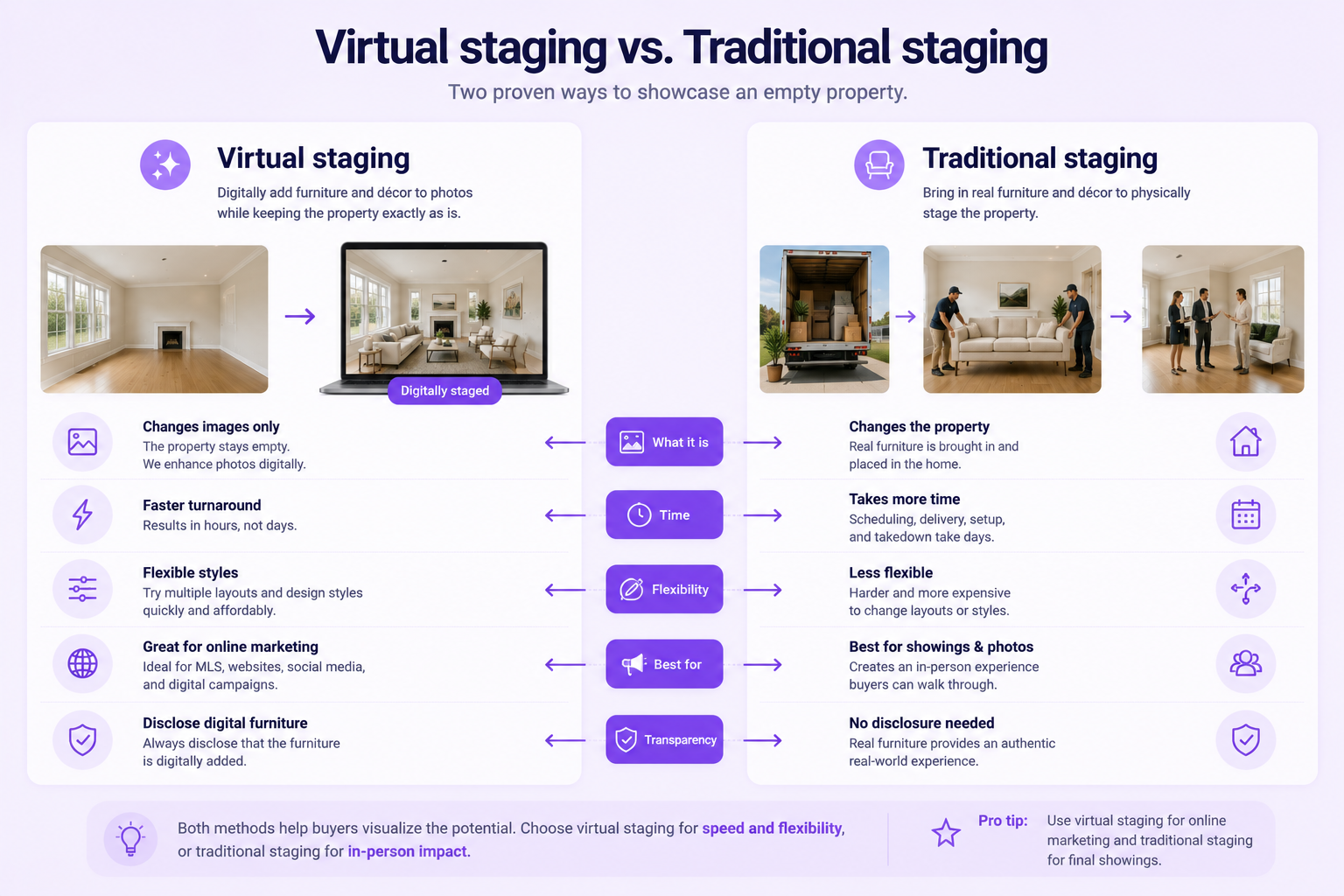
Virtual staging changes only the images. Traditional staging changes the actual rooms.
Primary Benefit
Virtual staging strengthens online presentation. Traditional staging improves both online presentation and physical showings.
Speed
Virtual staging can usually be prepared without furniture delivery or room installation. Traditional staging requires planning, transport, setup, and removal.
Flexibility
Virtual staging can test multiple styles or room functions from the same photo. Physical staging is less flexible once furniture is installed.
Buyer Experience
Virtual staging helps viewers imagine the room online. Traditional staging allows buyers to experience the furnished layout in person.
Storage and Logistics
Virtual staging requires no furniture storage or transport. Traditional staging may involve rental, delivery, installation, insurance, and pickup.
Disclosure
Digitally added furniture should be disclosed clearly enough to avoid confusion. Physical furniture normally requires no digital-edit disclosure.
Cost Differences
Virtual staging is often the lower-cost option because it does not require furniture rental, delivery, installation, storage, maintenance, or removal.
Traditional staging costs depend on property size, location, staging duration, furniture quality, transport, labor, insurance, and the number of rooms.
A partial traditional staging plan may reduce cost by furnishing only high-impact rooms such as the living room, primary bedroom, dining area, and entry.
Virtual staging can also be limited to the most important listing images. The best comparison is therefore not only digital versus physical, but also how many rooms and how many final images are needed.
Which Is Faster?
Virtual staging can move quickly because it begins after the room is photographed. There is no need to coordinate furniture availability, delivery windows, installation crews, or removal.
Traditional staging requires more scheduling. The property may need cleaning, decluttering, minor repairs, furniture selection, transport, arrangement, and final styling before photography.
When a listing must launch quickly, virtual staging can be useful. When the property will remain on the market and receive many in-person viewings, the added setup time of traditional staging may be justified.
Which Looks More Realistic?
Traditional staging uses real furniture in the real room, so the physical interaction between objects, lighting, shadows, reflections, and space is naturally consistent.
High-quality virtual staging can also look convincing, but it must match the room’s perspective, scale, lighting direction, image sharpness, contact shadows, and architectural boundaries.
Poor virtual staging may include floating furniture, incorrect proportions, blocked doors, warped chairs, repeated decor, unrealistic windows, or lighting that does not match the room.
The realism of virtual staging depends heavily on the source photo and quality-control process.
Which Better Shows Room Scale?
Both methods can help viewers understand scale, but both can also mislead when used poorly.
Traditional staging uses physical furniture, which creates a real scale reference. However, carefully selected small furniture can still make a room appear more spacious.
Virtual staging must use doors, windows, flooring, ceiling height, and built-in features as visual scale references. Furniture that is too small or too large can distort how viewers perceive the room.
Furniture placement should demonstrate a practical layout rather than maximize the apparent size of the room.
Online Listing Performance
Most buyers first encounter a property through strong real estate listing photos. Empty rooms may be difficult to interpret, particularly when walls and flooring offer few scale references.
Virtual staging can make online images more understandable by showing a possible living-room arrangement, bedroom layout, dining zone, office, or studio-apartment plan.
Traditional staging also produces furnished listing photographs, with the additional benefit that the online images match the physical property during viewings.
For marketing that depends mainly on listing portals, advertisements, and social content, virtual staging may provide enough visual context. For high-touch sales involving repeated in-person visits, physical staging may provide more continuity.
In-Person Buyer Experience
This is the largest practical difference between the two methods.
A virtually staged listing may show a warm furnished living room online, but the buyer may enter an empty property. That contrast is acceptable when the listing is transparent, but it can feel disappointing when expectations are not managed.
Traditional staging allows visitors to experience furniture scale, room zones, walking paths, lighting, and atmosphere directly.
Physical furniture may also help buyers spend more time in the property and understand unusual layouts, but it can hide floor area or distract from architectural details if overused.
Design Flexibility
Virtual staging allows the same room to be presented in several styles, such as modern, Scandinavian, traditional, luxury, coastal, or minimalist.
It can also test alternative room functions. A spare room might be shown as a home office, guest bedroom, nursery, or workout space.
Traditional staging is less flexible because each layout requires physical changes. However, the chosen arrangement can be experienced from every angle during a viewing.
For a public listing, use one coherent primary presentation rather than publishing many conflicting versions that confuse viewers.
Best Properties for Virtual Staging
Vacant Homes
Empty homes are the clearest use case because the original room provides an unobstructed base for digital furniture.
New Developments
Unfurnished apartments and model units can be presented with several interior styles without furnishing every available unit.
Investment Properties
Virtual staging can help demonstrate possible use while keeping the property available for renovation, inspection, or rapid turnover.
Remote Listings
When marketing relies heavily on online viewing, digital staging can add context to listing photographs.
Properties with Limited Access
Virtual staging may help when furniture delivery, storage, stairs, elevators, construction schedules, or building restrictions make physical staging difficult.
Multiple Layout Concepts
Digital staging can compare a room as an office, bedroom, dining space, or living area before choosing the strongest listing direction.
Best Properties for Traditional Staging
High-Value Listings
A premium property may benefit from a complete physical experience that supports professional photography, private showings, and events.
Homes with Unusual Layouts
Real furniture can help visitors understand difficult room proportions, circulation, open-plan zones, or awkward corners.
Owner-Occupied Homes
A stager can reorganize, reduce, or supplement existing furnishings rather than starting from an empty room.
Properties with Frequent Viewings
When many buyers will visit in person, physical staging helps the home match the marketing images.
Lifestyle-Driven Sales
Properties marketed through atmosphere, entertaining space, family living, or luxury experience may benefit from real furniture and decor.
Vacant Properties
Virtual staging is particularly efficient for vacant properties because furniture can be added without first removing existing objects.
The original empty-room image should still be preserved. Publishing both versions can help viewers distinguish the real property from the suggested layout.
Traditional staging may be more effective when the property’s empty state makes in-person visits feel cold, unfinished, or difficult to understand.
Occupied Properties
Traditional staging often works better when the owner’s existing furniture can be edited, rearranged, or supplemented.
Virtual staging an occupied room may require digital furniture removal before new objects can be added. This increases the risk of altered flooring, walls, fixtures, shadows, and architecture.
When using digital decluttering or furniture replacement, permanent property conditions must remain visible and accurate.
Can You Combine Both Methods?
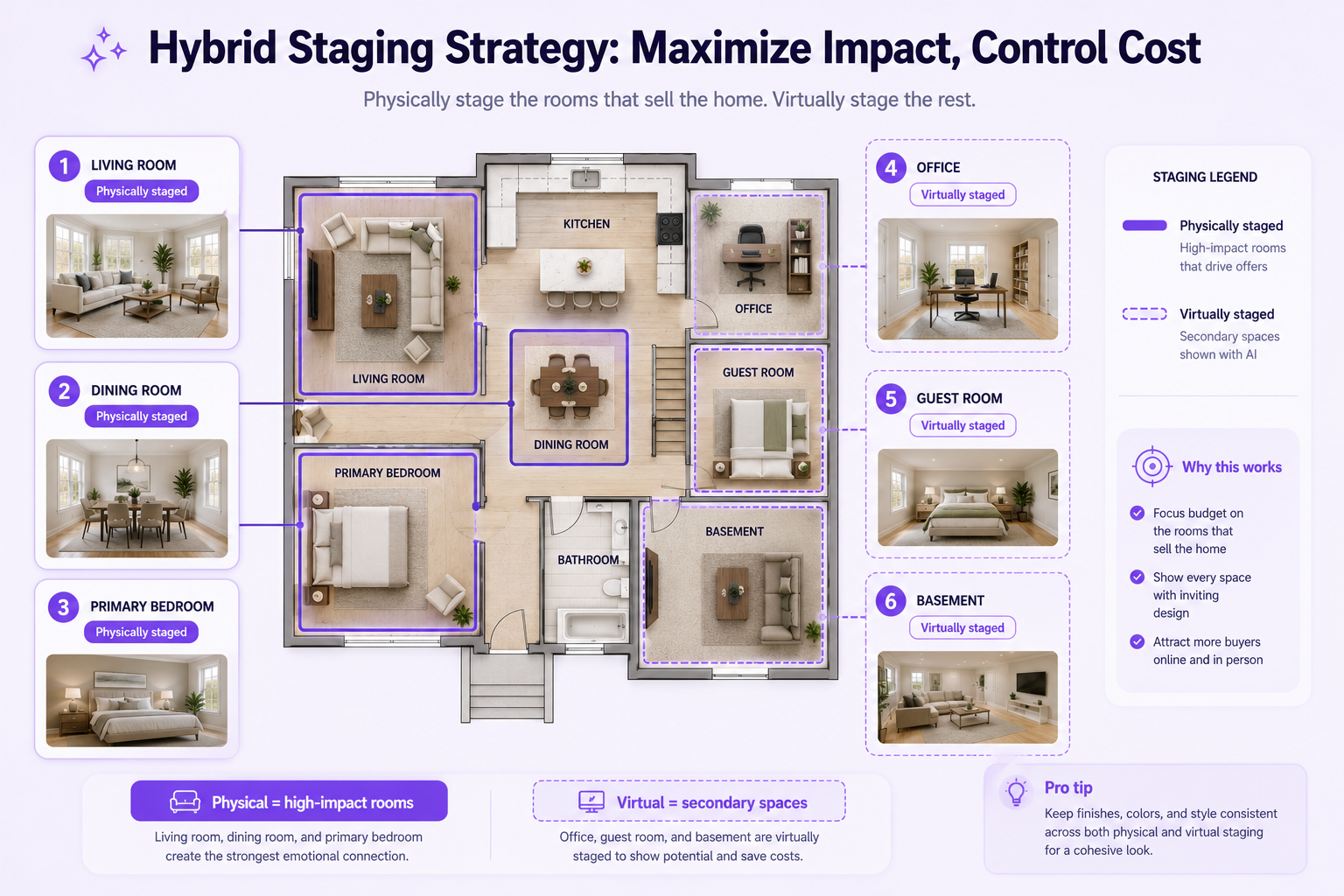
Yes. A hybrid strategy can use physical staging in the most important rooms and virtual staging for secondary spaces.
For example, the living room, dining room, and primary bedroom may be physically staged, while an empty office, basement, or guest room is virtually staged.
Another option is light physical staging with a few real pieces, followed by limited digital enhancement for artwork, rugs, or decor.
Every digitally added element should still be reviewed and disclosed appropriately.
Virtual Staging Advantages
No furniture delivery, storage, installation, maintenance, or pickup.
Multiple design styles can be tested from one source image.
Useful for vacant properties and remote marketing.
Can stage secondary rooms that may not justify physical furniture.
Makes it easier to create listing, social, brochure, and advertising variations.
The original empty room can remain available for transparent before-and-after presentation.
Virtual Staging Limitations
The property remains empty during an in-person viewing.
Poor edits may distort architecture, scale, lighting, furniture, or room proportions.
Digitally added furniture can create unrealistic expectations when disclosure is unclear.
It cannot improve the physical atmosphere, sound, smell, comfort, or visitor experience.
Occupied or cluttered rooms may require difficult object removal before staging.
Listing platforms, brokerages, and local markets may have specific disclosure requirements.
Traditional Staging Advantages
The online images and physical property can present the same furnished layout.
Buyers can experience scale, flow, seating, and room function in person.
Real objects naturally interact with lighting, shadows, reflections, and architecture.
A stager can address decluttering, furniture arrangement, styling, and presentation throughout the home.
It can support open houses, private viewings, video, walkthroughs, and photography from multiple angles.
Traditional Staging Limitations
Furniture rental, transport, labor, storage, insurance, maintenance, and removal may increase cost.
Scheduling can delay photography or listing launch.
Furniture may become damaged or unavailable during the listing period.
One physical setup offers less design flexibility than digital variations.
Large or occupied properties may require extensive preparation.
Over-staging can make rooms look smaller or distract from permanent features.
Disclosure and Listing Accuracy
Virtual staging should not be used to hide defects, change permanent architecture, enlarge rooms, improve views, add windows, replace flooring, complete renovations, or create amenities that do not exist.
A clear label such as virtually staged or digitally staged can help viewers understand that furniture and decor were added to the image.
Rules differ by listing platform, brokerage, photographer, professional association, and location. Review current requirements before publication.
When practical, include the original empty-room image alongside the staged version.
What Virtual Staging Must Preserve
Room dimensions and floor area.
Walls, windows, doors, and ceiling height.
Flooring, tiles, built-in storage, fireplaces, and permanent fixtures.
Views through windows and doors.
Visible property condition, including material defects.
Camera perspective and the original room geometry.
How to Evaluate Virtual Staging Quality
Furniture Scale
Use doors, windows, floorboards, sockets, and ceiling height to confirm that furniture is correctly sized.
Perspective
Furniture edges should follow the room’s vanishing lines and sit on the real floor plane.
Shadows
Every object should have realistic contact shadows that follow the room’s light direction.
Architecture
Compare windows, doors, walls, flooring, fixtures, and built-ins with the original image.
Circulation
Furniture should leave practical walking paths and avoid blocking doors, windows, radiators, vents, and storage.
Generated Details
Inspect chair legs, lamps, plants, books, artwork, textiles, mirrors, and repeated decorative objects.
How to Evaluate Traditional Staging Quality
Room Function
The furniture arrangement should make the intended use immediately understandable.
Scale and Flow
Furniture should fit the space and leave comfortable circulation.
Visual Clutter
Decor should create warmth without hiding floor area, storage, windows, or architectural features.
Property Alignment
The style should fit the architecture, price point, neighborhood, and likely audience.
Photography Readiness
Textiles, cushions, tables, curtains, lamps, artwork, and accessories should be aligned before photography.
How to Choose Between Virtual and Traditional Staging
Choose virtual staging when the priority is fast, flexible, and cost-controlled online presentation for an empty or difficult-to-furnish property.
Choose traditional staging when the in-person buyer experience is central, the property receives frequent viewings, or the layout is easier to understand with real furniture.
Use a hybrid approach when a few high-impact rooms justify physical staging but secondary spaces still need visual context.
The decision should be based on the complete marketing plan rather than a single listing photograph.
Decision Checklist
Will most serious buyers visit the property in person?
Is the home empty, occupied, partially furnished, or under construction?
How quickly must the listing launch?
How many rooms need staging?
Does the property have an unusual layout?
Will the staged setup be used for video and walkthroughs as well as photos?
What disclosure rules apply to the listing?
Does the marketing budget include furniture rental, logistics, and staging duration?
Would a hybrid strategy produce a better balance?
Final Recommendation
Virtual staging and traditional staging are not direct replacements in every situation. They affect different parts of the property-marketing experience.
Virtual staging is strongest when the goal is to improve online images quickly and demonstrate possible furniture layouts. Traditional staging is strongest when the physical property must create the same furnished impression during viewings.
Virtual staging software provides a template-first workflow for empty living rooms, bedrooms, dining rooms, offices, kitchens, and other interiors. Upload a real room photo, choose an interior style, and create staged variations while preserving the property’s architecture.
FAQ
What is the difference between virtual staging and traditional staging?
Virtual staging adds digital furniture to listing photos, while traditional staging places real furniture and decor inside the physical property.
Is virtual staging cheaper than traditional staging?
Virtual staging is often less expensive because it does not require furniture rental, transport, installation, storage, maintenance, or removal.
Is virtual staging realistic?
It can be realistic when furniture scale, perspective, lighting, shadows, sharpness, and architecture are handled carefully.
Does virtual staging help during in-person viewings?
It helps viewers understand the room online, but the physical property remains empty unless it is also traditionally staged.
Which rooms should be traditionally staged?
High-impact rooms such as the living room, primary bedroom, dining area, and entry are common priorities for physical staging.
Can virtual and traditional staging be combined?
Yes. Main rooms can be physically staged while secondary rooms are virtually staged, or light physical staging can be supplemented digitally.
Should virtual staging be disclosed?
Disclosure rules vary, but digital furniture should generally be identified clearly enough to prevent viewers from believing it is physically present.
Does GenImagePro require a virtual staging prompt?
Not always. GenImagePro provides ready-made interior templates, allowing users to upload a room photo and choose a staging style.