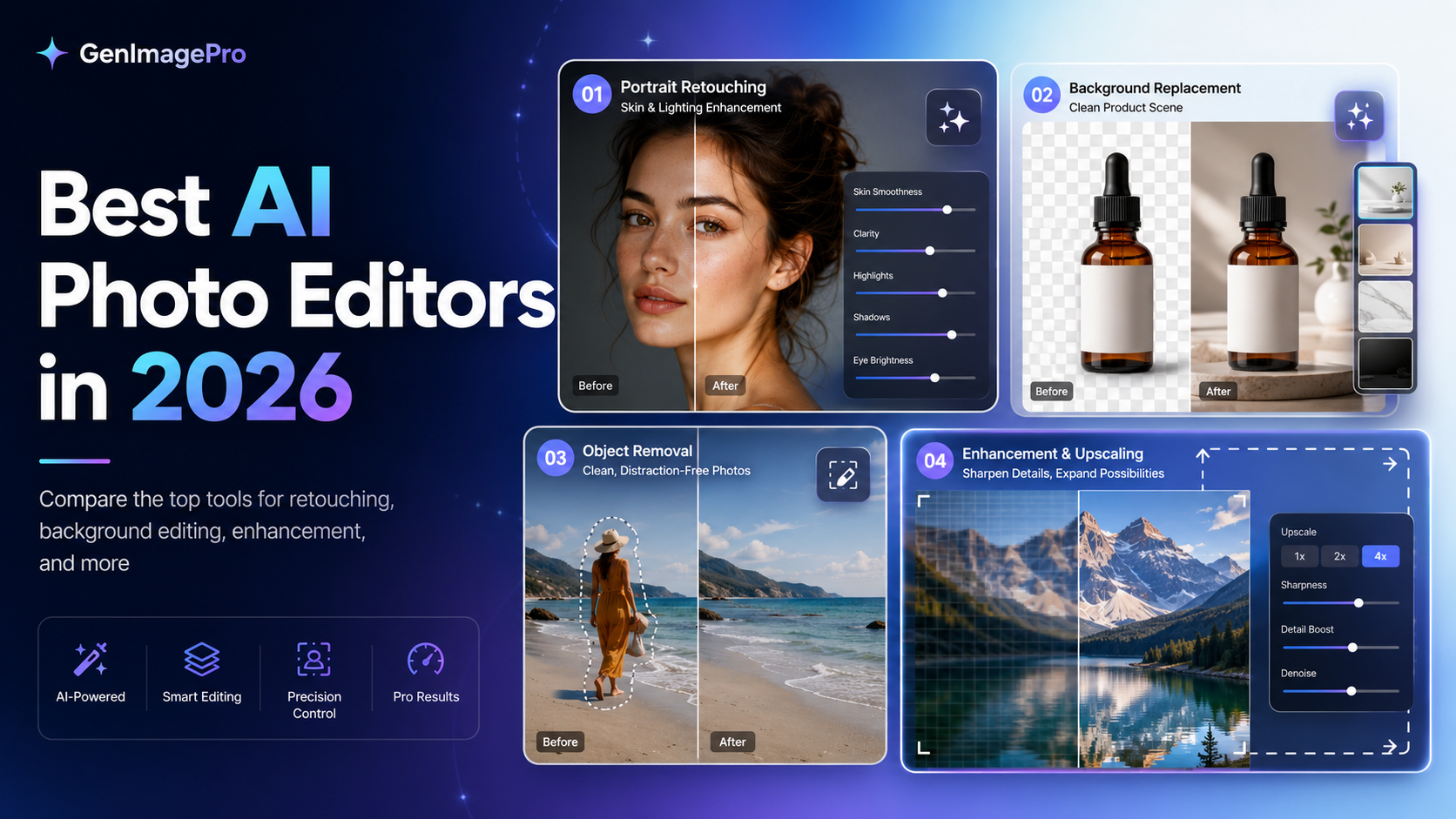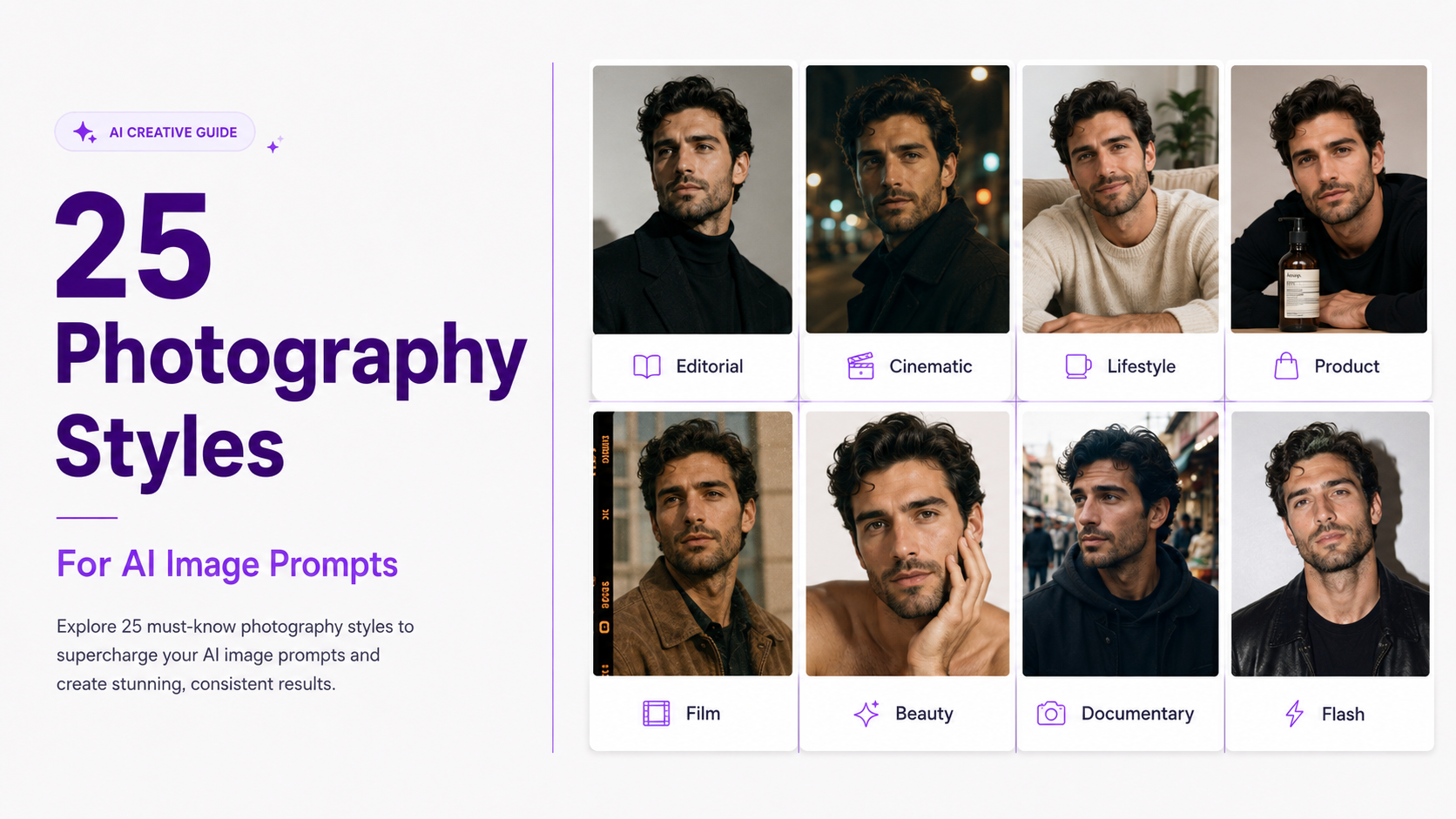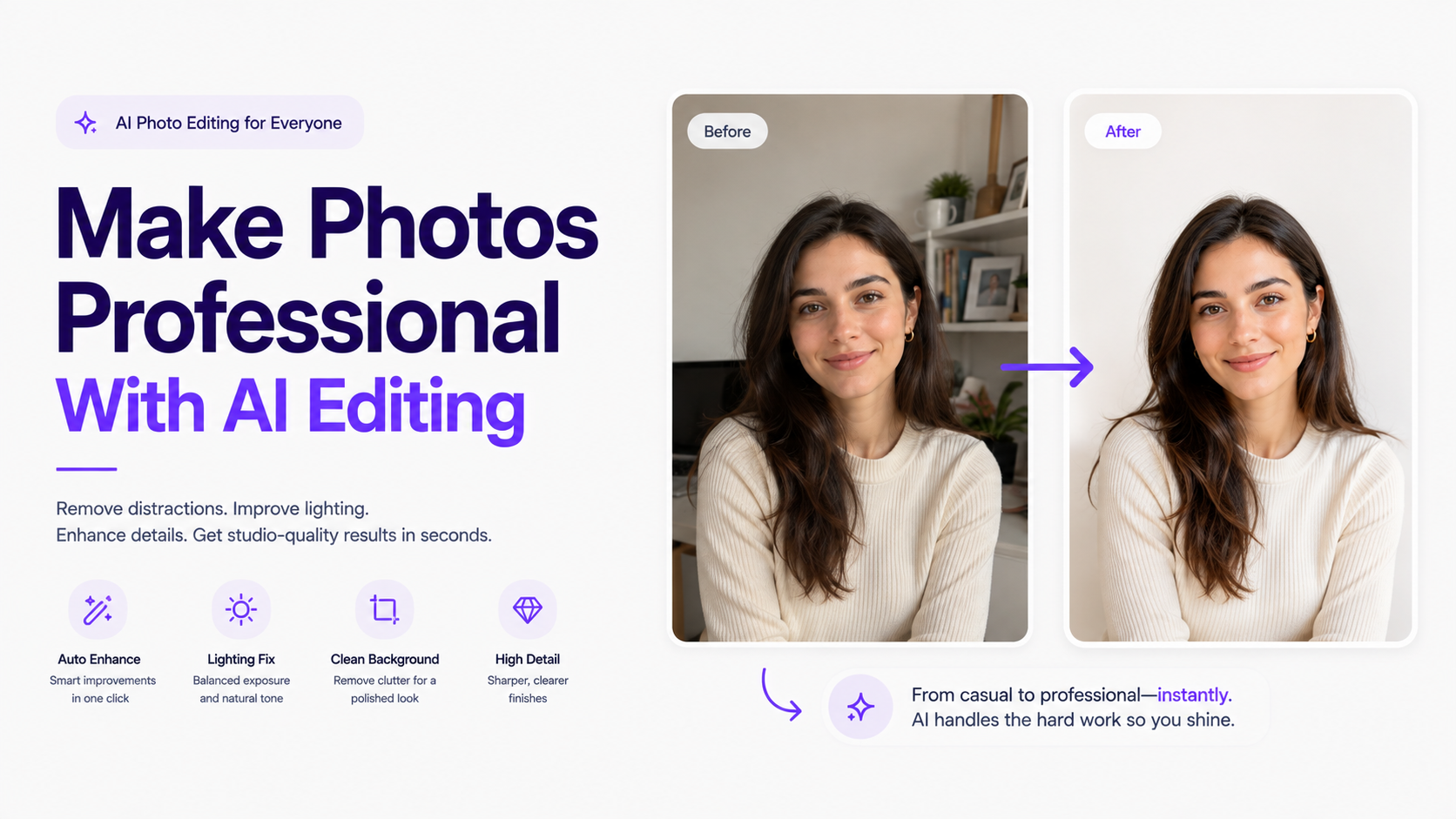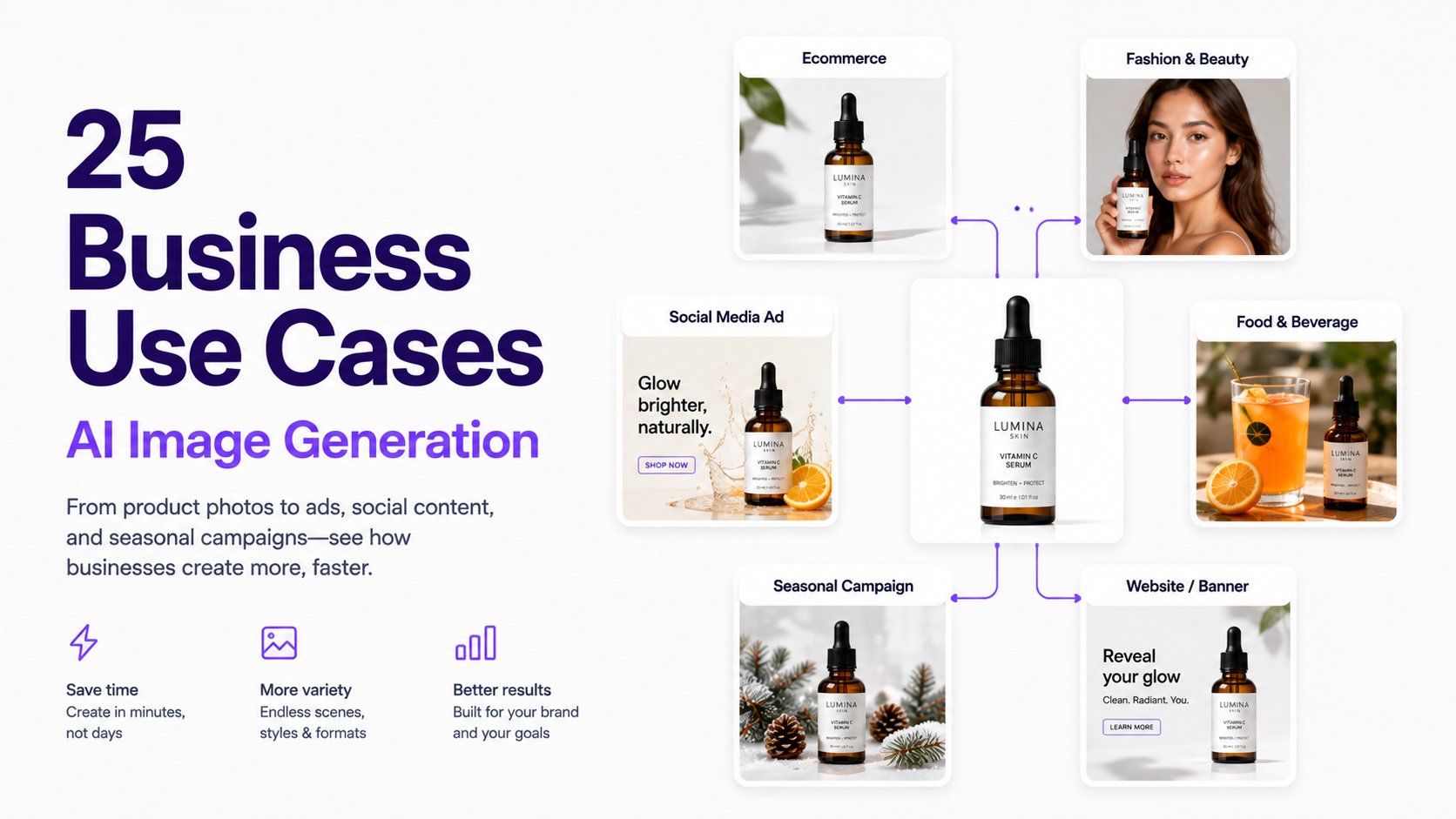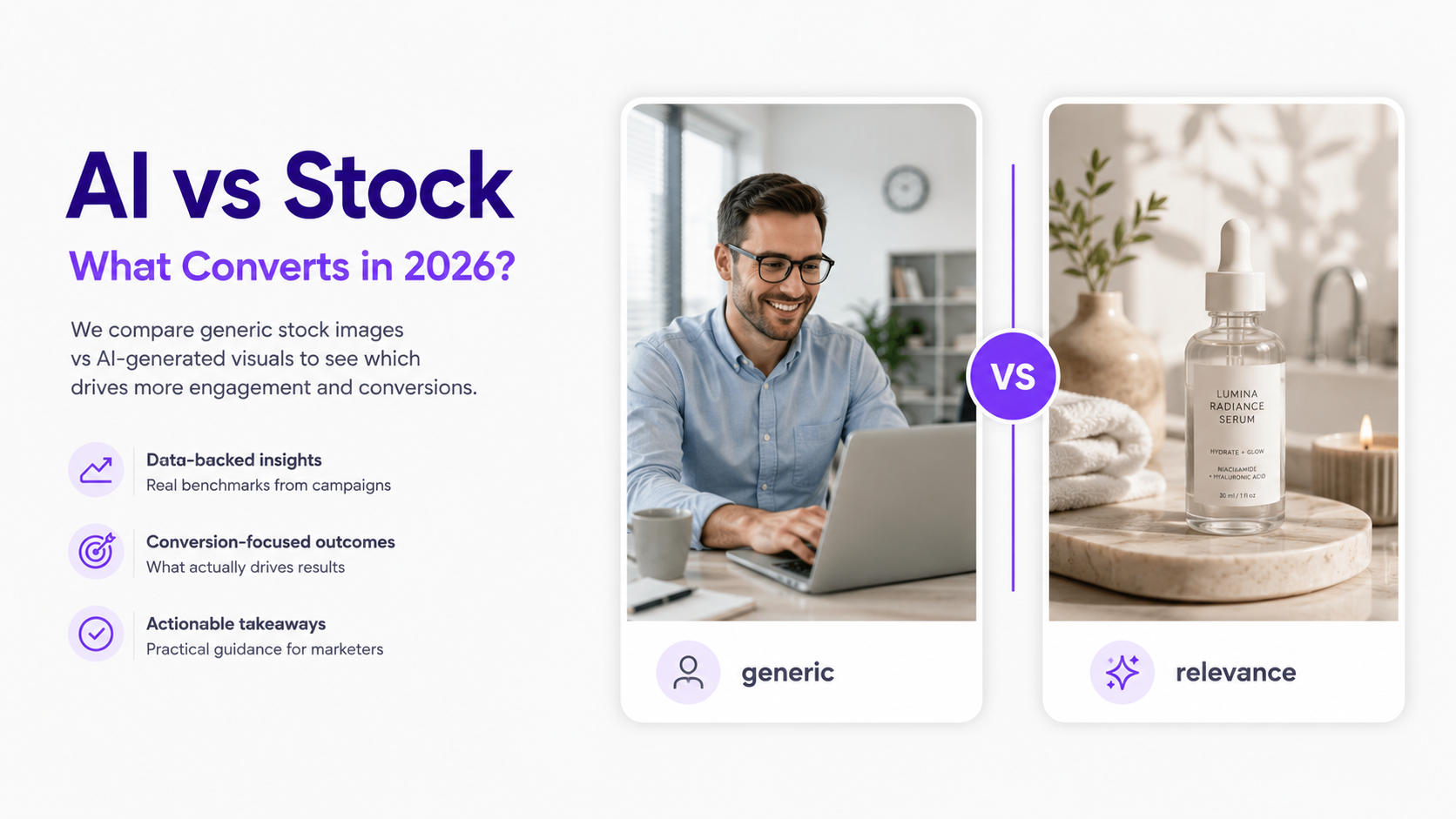
AI can produce campaign visuals, lifestyle scenes, product shots, and ad concepts in seconds. That raises a marketing question: if imagery can be built for your product and audience, should it convert better than generic stock photography?
The evidence does not support a universal yes. AI images can match stock photography and sometimes outperform it in ads—but original photography still wins when shoppers need proof of a real person, place, service, or product.
Source alone does not decide conversion. Relevance, authenticity, quality, product accuracy, context, and how synthetic the image looks usually matter more.
Quick Answer: Do AI Images Convert Better Than Stock Photos?
Sometimes, but not automatically. High-quality AI can match stock on websites, and large-scale ad data suggests higher CTR when AI creatives do not visibly look synthetic.
Artificiality and AI disclosure can reduce trust. Original photos are often more persuasive when buyers need evidence of condition, fit, service quality, or authenticity.
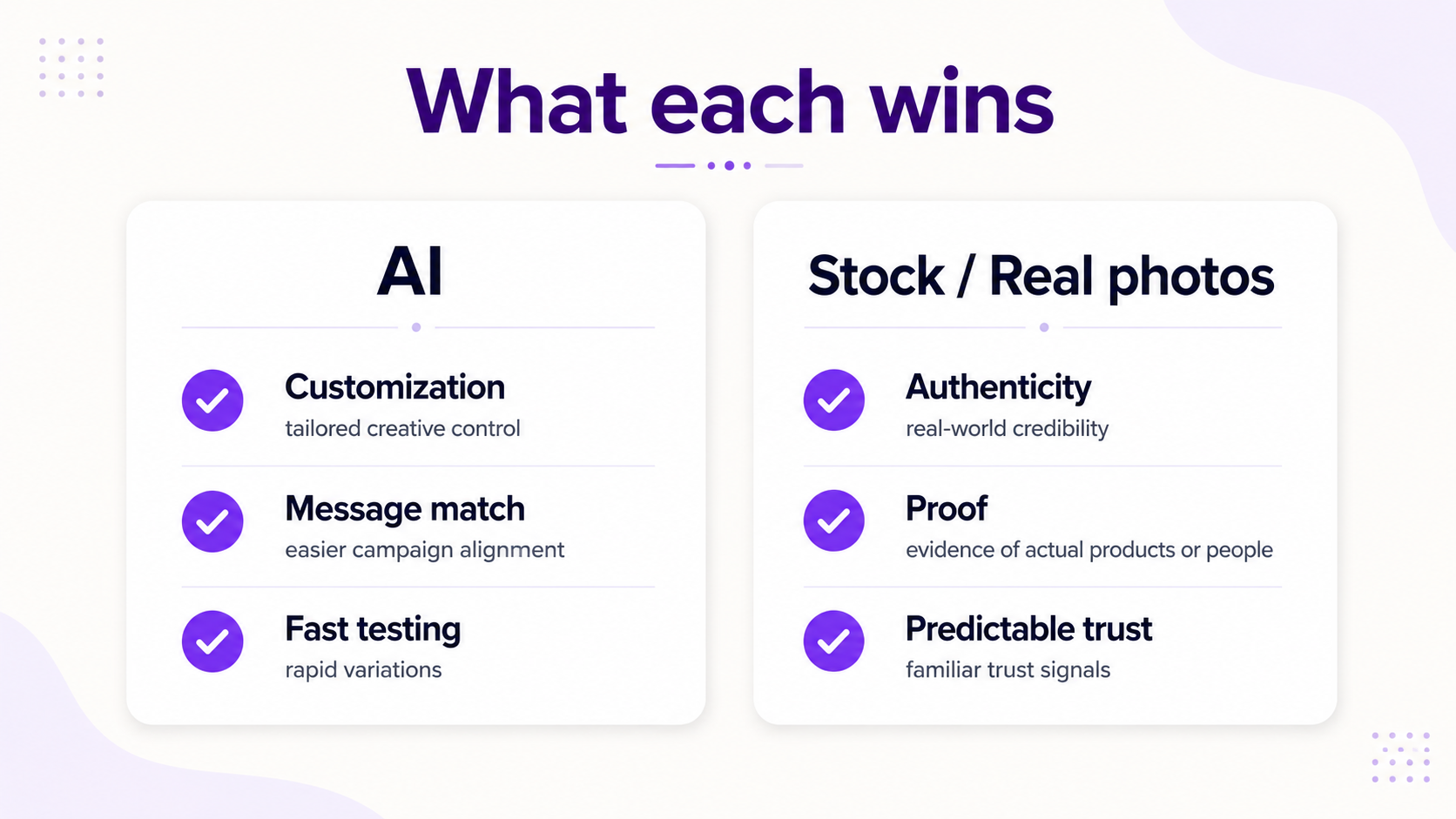
Use AI when it creates imagery more relevant, specific, and testable than stock. Use real photography when the image must prove something about reality.
What the Latest Research Says
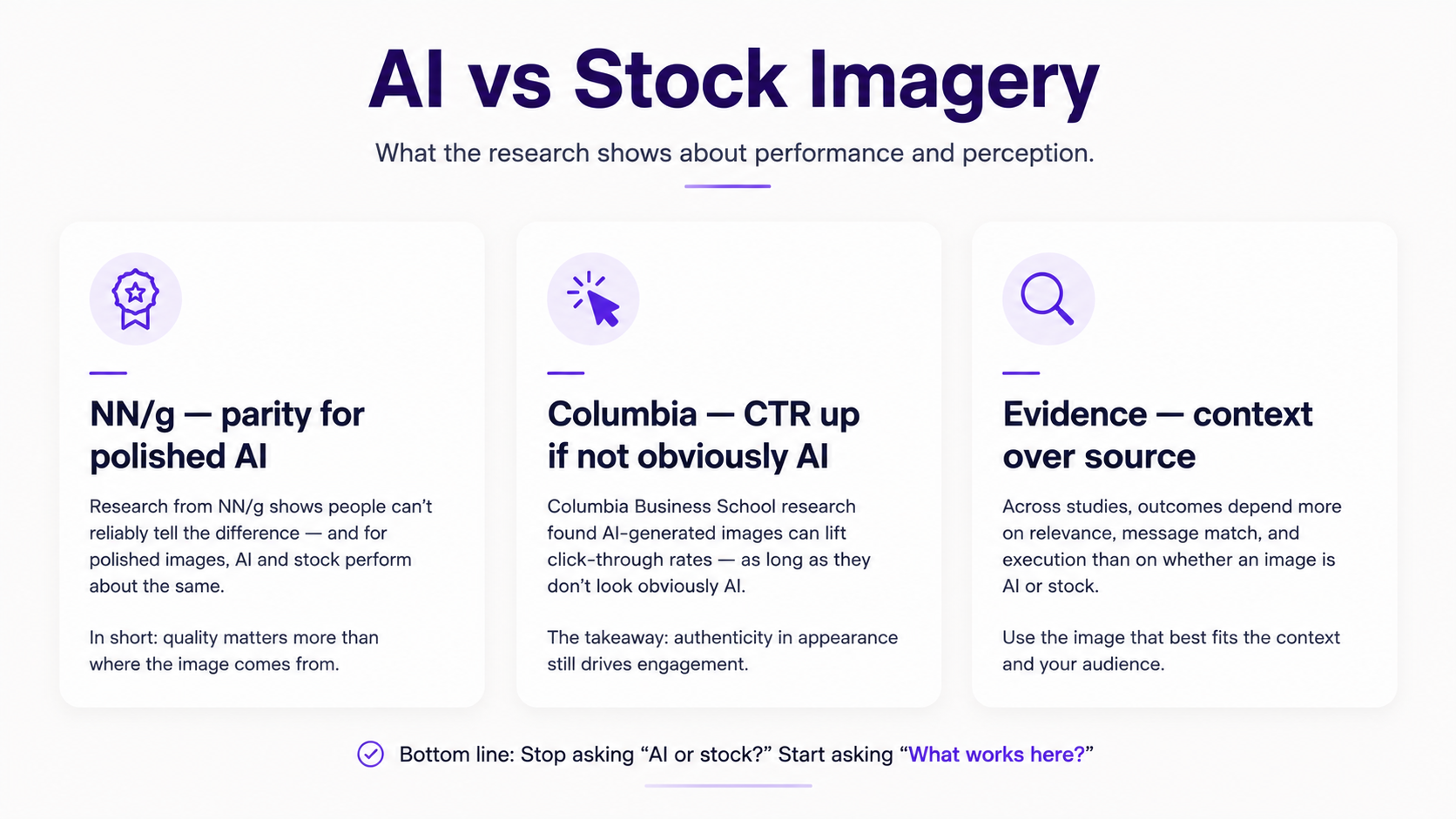
AI Images Can Perform as Well as Stock Photography
In August 2026, Nielsen Norman Group compared AI website hero images with stock photos. Seventy-seven U.S. participants evaluated fictional pages with three AI and three stock images, without being told which were AI.
AI versions had no meaningful trust or professionalism penalty and scored slightly higher on average, though only six images were tested. The key finding was parity: polished AI imagery was not inherently less credible.
AI Advertising Can Outperform—If It Does Not Look Like AI
A 2026 Columbia Business School working paper analyzed over two million ad-day observations from 7,000+ advertisers across nearly 50 categories—16+ billion impressions and 116 million clicks.
AI-image ads achieved higher CTR than human-made imagery—but only when they did not visibly look AI-generated. The study measured clicks, not purchases. Visible artificiality is the bigger problem than AI itself.
Stock Photos, Original Photography, and AI Are Not the Same
Separate three categories: generic stock, original photography, and AI imagery. Much of the case against stock is really a case against irrelevant, decorative images—not against photography itself.
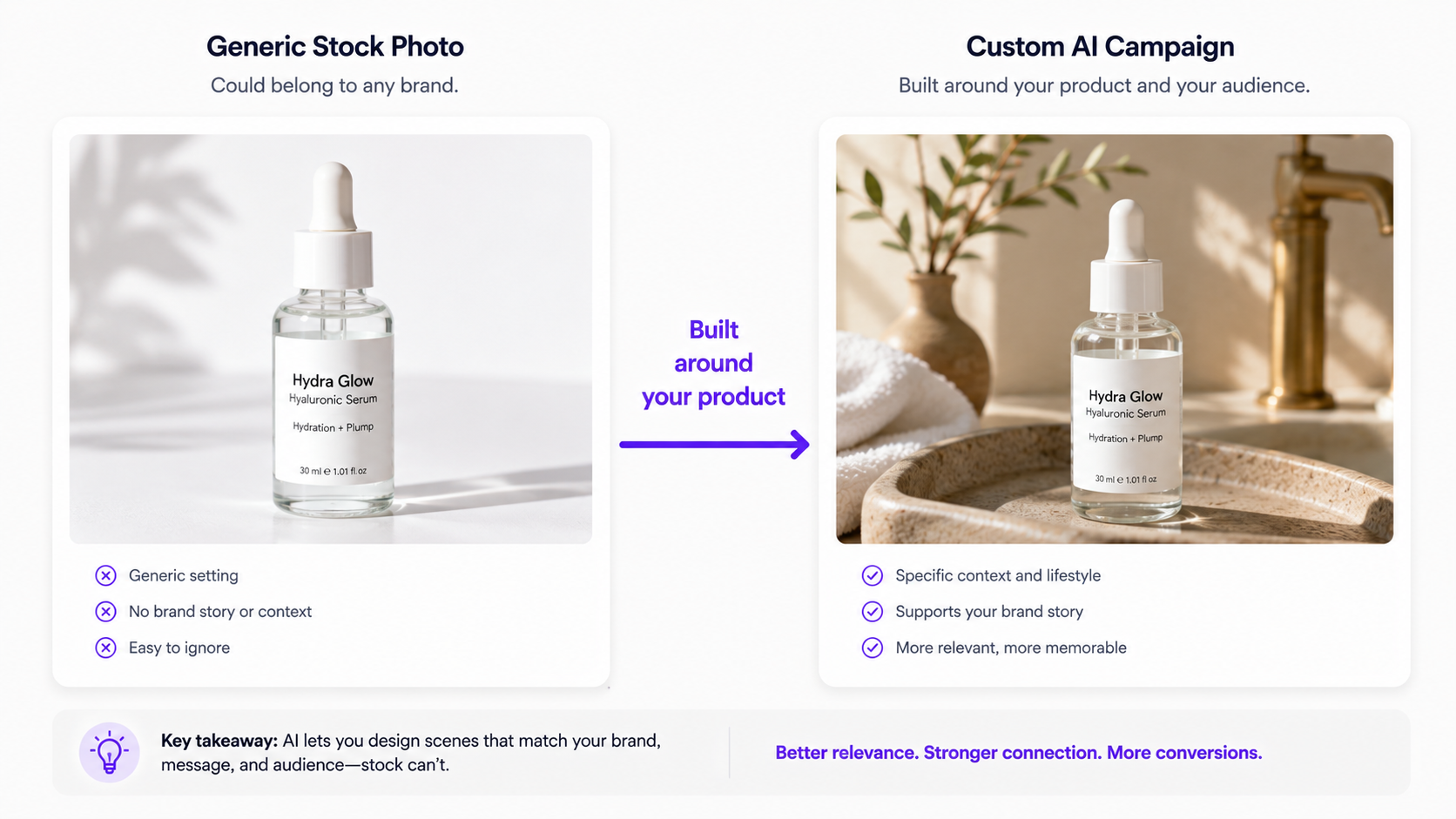
Stock can look professional while saying little about your offer. Original photography shows your people, product, or place. AI sits between: it may not document a shoot, but it can be built for your product, audience, campaign, and message—where much of its conversion potential comes from.
Why Generic Stock Photos Often Underperform
Stock is not inherently bad; the problem is decoration instead of communication. NN/g research has long found users attend to informative images and ignore decorative ones—smiling call-center agents and generic laptop teams included.
Classic Conversion Tests
MarketingExperiments tested a stock customer-service model against a photo of the actual founder on a credit counseling site. The real-person version lifted consultation signups 35%—familiarity and credibility the anonymous model could not provide.
A VWO case study for 160 Driving Academy replaced a stock truck-driver image with an actual student and saw a substantial conversion lift. Connection to the real offer mattered more than the production method.
Why AI Images Can Convert Better Than Stock Photos
1. Specificity to the Offer
A stock library may have attractive skincare shots, but not your exact product, packaging, palette, and message. A reference-based AI workflow can start from your product and build the scene around it.
2. Message Match
Conversion improves when ad, page, offer, and image feel like one message. If the headline is 'Designed for small apartments,' show the product in a compact apartment—not a vaguely related stock interior.
3. More Variants to Test
AI's advantage may not be that the first AI image beats the first stock image—it is cheaper tenth and fiftieth variations: environments, subjects, seasons, angles, and audience contexts.
4. Exact Composition and Less Visual Repetition
Stock is shot before you know your layout. AI can add negative space for headlines, create mobile/square/wide versions, and produce campaign-unique assets instead of creatives shoppers have already seen elsewhere.
5. Adapt a Real Product Instead of Inventing One
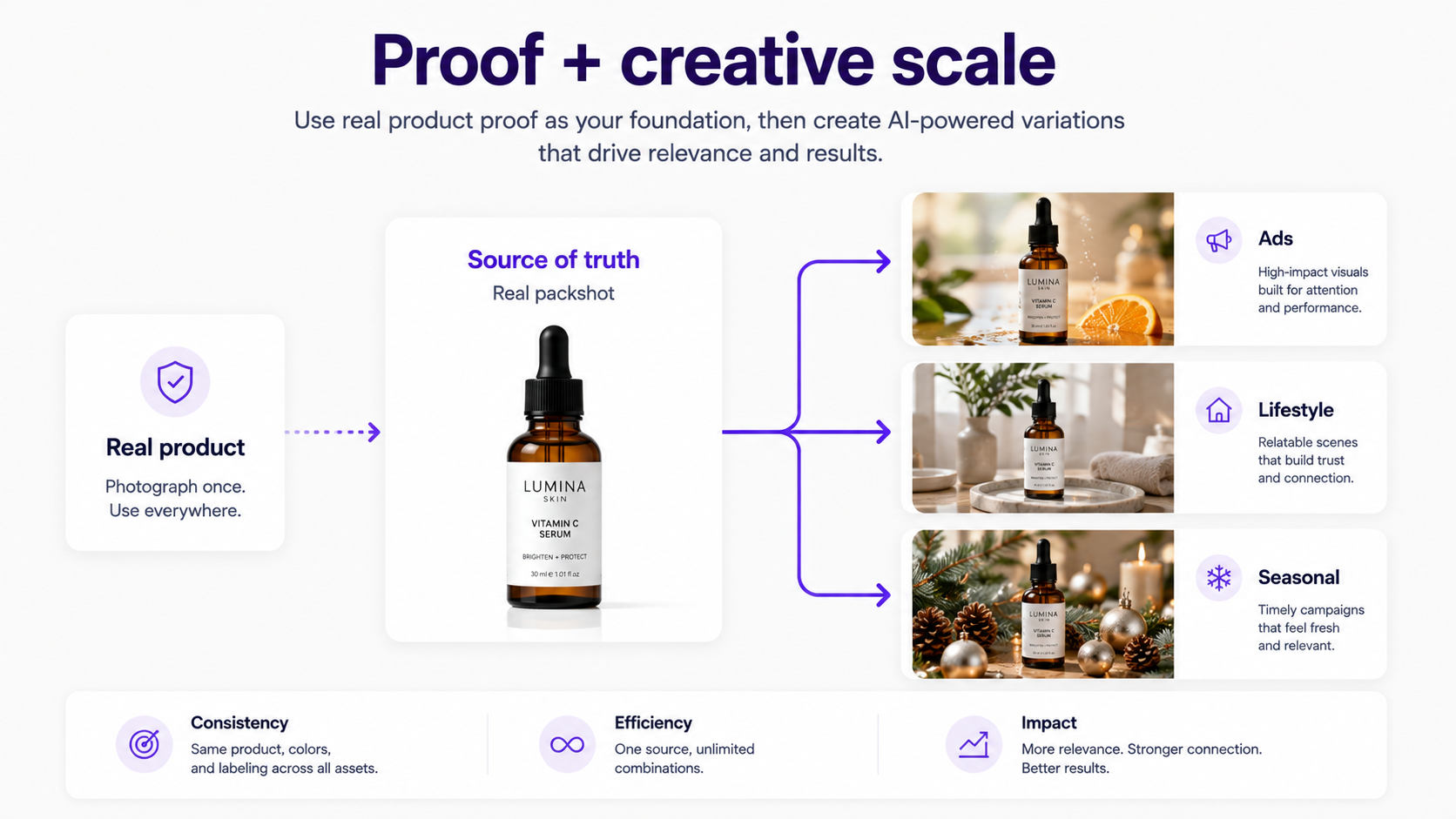
The strongest commercial workflow is often image-to-image: keep the real product accurate, then use AI for lighting, environment, seasonal styling, or composition.
When AI Images Can Perform Worse
Columbia's research suggests AI ads win when they do not look AI-generated. Artificial skin, bad anatomy, impossible reflections, warped objects, and exaggerated perfection create friction even when users cannot name the issue.
Sometimes the image's job is proof—garment condition, a real hotel room, an actual clinic, handmade finish. Synthetic visuals can remove what customers need. Changing labels, geometry, materials, or fit also hurts conversion by misrepresenting the product.
A 2026 CHI study found aesthetic preference for AI sites before disclosure, then trust shifted to photography after disclosure—especially in healthcare and government. Replacing generic stock with generic AI also fails if nothing specific about the offer is communicated.
What About Ecommerce Product Images?
Ecommerce sits between persuasion and evidence. Better images attract attention; shoppers still need fidelity to what will arrive.
A 2026 Vinted Field Experiment
A 2026 Vinted preprint compared original vs AI product images on second-hand listings. In one seasonal wave AI led engagement; in another, originals won—especially inquiries. Authors saw a trade-off between polish and verification. Transaction counts were small, but different images clearly do different jobs in the funnel.
The Best Ecommerce Strategy Is Often Hybrid
Keep accurate originals where shoppers inspect the item. Use AI from the same product reference for ads, heroes, lifestyle scenes, seasonal campaigns, and social creatives.
Landing Pages, Ads, Blog, and SaaS
For landing pages, ask what the hero must do. Use AI to visualize the outcome; use real photography when people or places build trust; skip stock that adds no information.
Paid ads are a strong AI use case because variation is cheap to test. Test hypotheses (lifestyle vs product-only, studio vs home)—not merely stock vs random AI. Twenty credible variants beat two.
For blogs, topic-specific diagrams and before-and-afters beat generic laptop stock. For SaaS, tie visuals to the workflow—and keep screenshots, customers, and real team photos as proof.
Where GenImagePro Fits
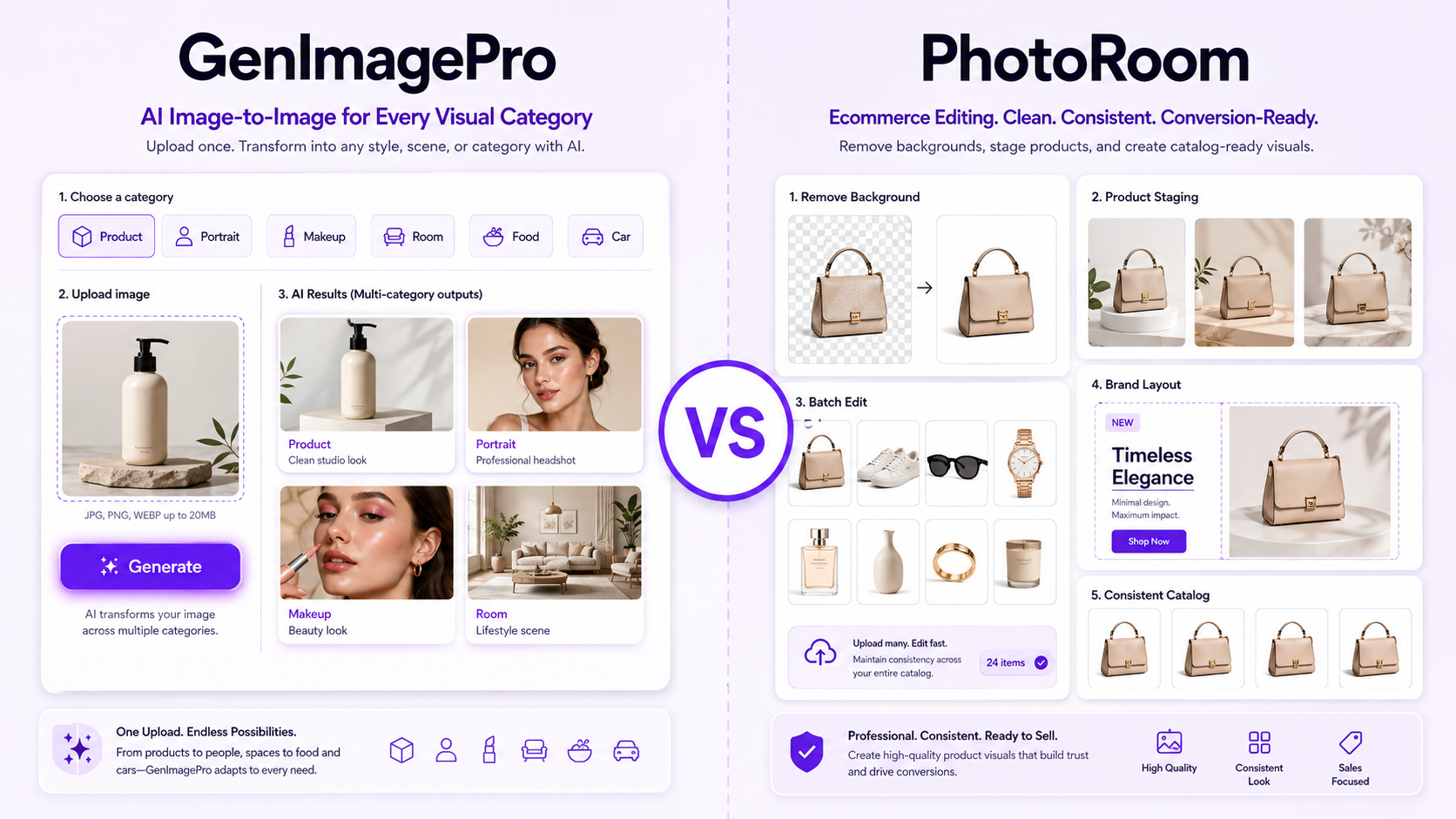
GenImagePro focuses on the commercially useful path: start from an existing image and transform it into a more specific visual, rather than relying only on fully synthetic text-to-image generation.
Upload a product, portrait, fashion, food, or other source and generate scenes, photoshoots, backgrounds, beauty looks, and campaign variations. For conversion, match the product, audience, and message while preserving details that matter.
When to Use AI, Stock, or Original Photography
Use AI for customized campaigns, many variations, aspect ratios, seasonal scenes, lifestyle contexts, and blog illustrations—when results stay realistic, specific, and accurate.
Stock still works when customization is unnecessary, the right photo already exists, or review cost is not justified. Good stock can beat weak AI.
Use original photography when authenticity is the offer: testimonials, founders, employees, real estate, hospitality, healthcare, restaurants, product condition, second-hand items, before-and-afters, and events.
The Strongest Strategy: AI + Original Photography
The decision need not be binary: real products as source of truth with AI campaign environments; real team photos on About with AI concepts on educational pages; real testimonials with AI for ad testing. Authenticity where it matters; AI where scale matters.
How to Test AI Images Against Stock Photos Properly
Define one conversion goal. Keep headline, copy, CTA, layout, offer, and audience identical. Compare equivalent concepts—not irrelevant stock vs polished AI. Test several AI candidates. Measure down-funnel results (CTR without purchases is not a win). Inspect hands, faces, text, labels, materials, and proportions before launch.
What Actually Makes an Image Convert?
Relevance, specificity, credibility, product accuracy, quality, message match, distinctiveness, and testability matter more than whether the file came from stock, a camera, or a generator.
Final Verdict
There is no universal rule that AI converts better than stock. High-quality AI can match stock in perception tests; large-scale ad data shows CTR gains when creatives do not look synthetic; historical tests show relevant authentic imagery can beat generic stock.
AI's real advantage is customization and experimentation—and it disappears when results look fake, misrepresent the product, or damage trust. The winning image communicates value and confidence to act, often via original sources plus AI-assisted creative production.
FAQ
Do AI-generated images convert better than stock photos?
Not universally. High-quality AI can match stock and sometimes outperform ads. Relevance, quality, authenticity, accuracy, and how synthetic the image looks matter more than production method.
Do people trust AI-generated images?
It depends on context and disclosure. NN/g (2026) found no inherent trust penalty for polished AI vs stock when unlabeled. Other research shows AI disclosure can reduce trust in credibility-sensitive contexts.
Do AI-generated ads perform better?
Columbia (2026) found higher CTR for AI ad images that did not look AI-generated. CTR is not purchase conversion—test downstream results.
Why do stock photos sometimes reduce conversions?
Usually because generic stock provides little useful information about the real business, product, or offer—not simply because the image came from a stock library.
Are real photos better than AI images?
Real photos are preferable when customers need visual proof of something real: product condition, a location, an employee, a testimonial, or a before-and-after. AI is more useful when customization and creative variation are the main goals.
Should ecommerce stores use AI-generated product photos?
Use AI for lifestyle, campaigns, backgrounds, and ads around a real product. Keep the product accurate and keep originals available for color, material, condition, fit, and packaging checks.
Can AI-generated product images hurt conversion?
Yes—if the image looks artificial, changes important product characteristics, creates uncertainty about what will arrive, or removes visual evidence shoppers need.
Are AI images good for paid advertising?
Yes, especially because AI makes many visual variations inexpensive to test: environments, subjects, placements, angles, formats, and concepts.
What is the biggest advantage of AI images over stock photos?
Customization around your product, audience, composition, campaign message, brand direction, and aspect ratio instead of selecting an approximate library match.
What is the biggest disadvantage of AI marketing images?
They can reduce trust when they look obviously synthetic or when customers expect documentation of a real person, product, place, or event. They can also introduce inaccurate product details if outputs are not reviewed.
Can I combine real product photos with AI-generated backgrounds?
Yes. This hybrid image-to-image workflow is one of the strongest commercial uses of generative AI: the original photo provides product accuracy while AI creates alternative environments and campaign concepts.
Can GenImagePro create campaign images from a product photo?
Yes. GenImagePro is built for image-to-image: upload a product or source photo, choose a direction, and generate campaign scenes, backgrounds, photoshoots, and marketing variations while preserving important details.