Perfume product photography needs to communicate an invisible experience. The image cannot show scent directly, so it must use light, color, texture, materials, ingredients, and atmosphere to suggest freshness, warmth, sensuality, elegance, or energy.
At the same time, the real bottle must remain accurate. Glass shape, cap, atomizer, label, logo, typography, liquid color, fill level, reflections, and packaging proportions are all important product details.
A clean white-background image may be ideal for ecommerce, while stone, water, flowers, fabric, dark glass, or architectural scenes may be better for campaigns and social content.
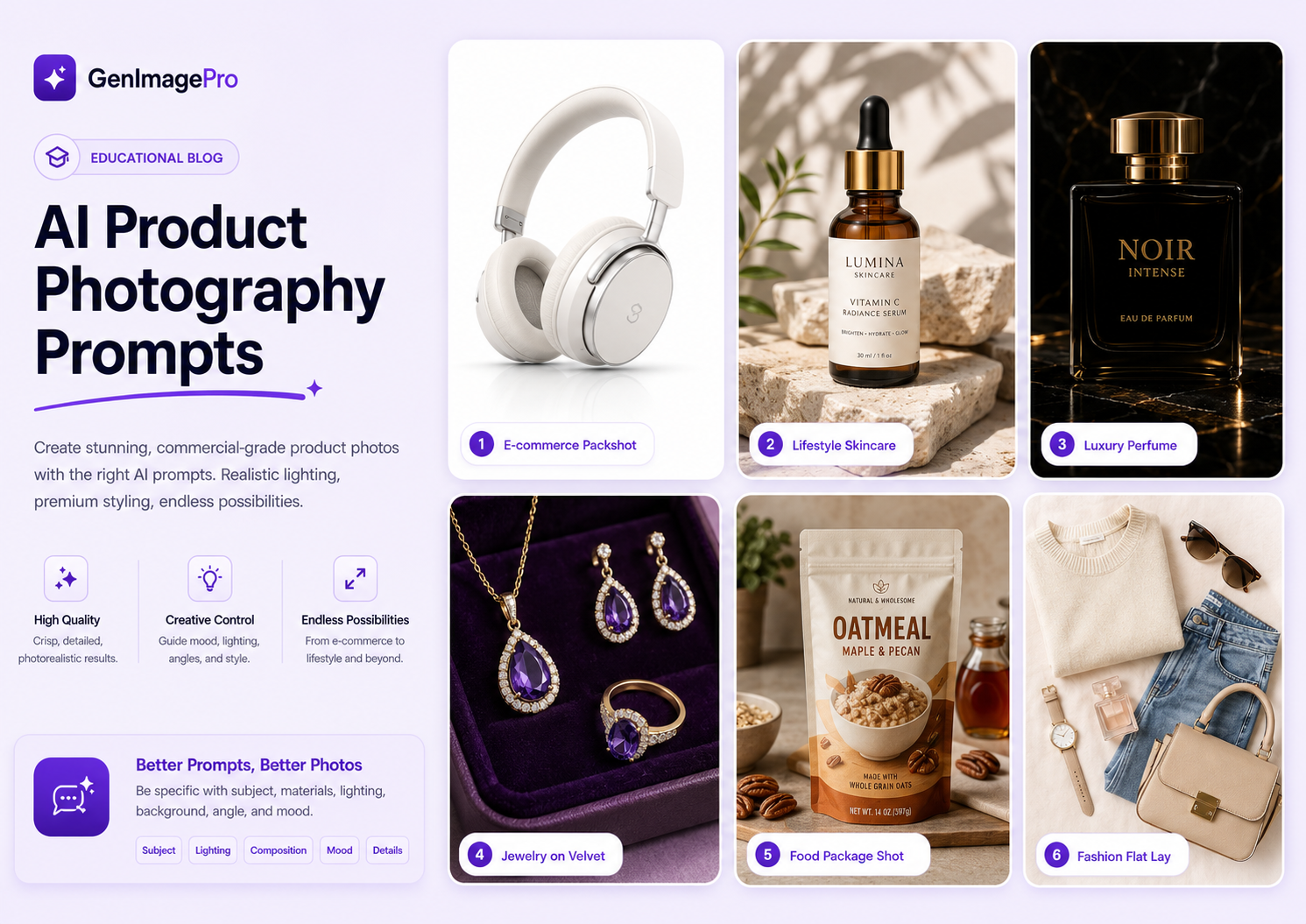
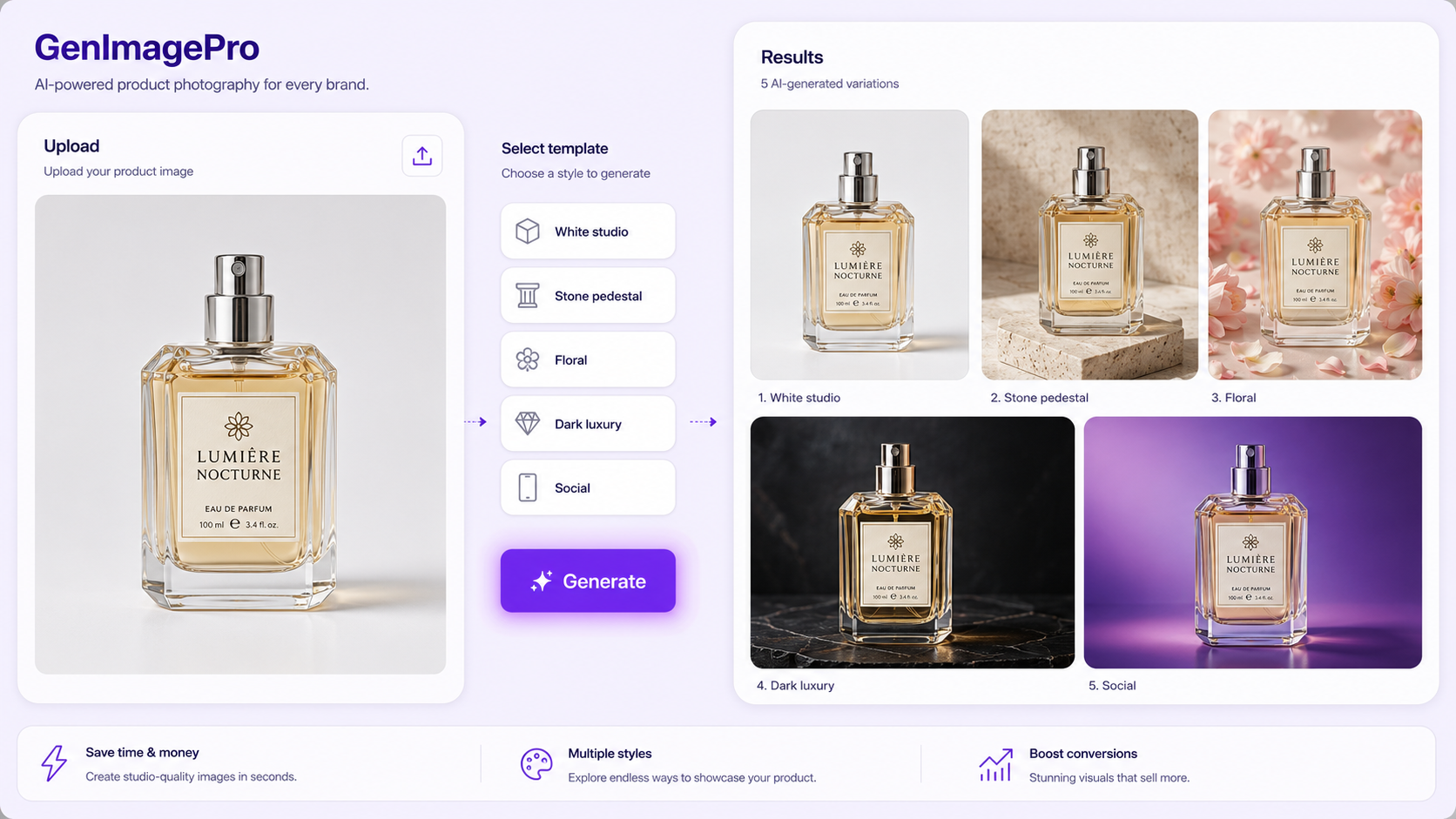
AI product photo generators can help create several perfume visuals from one clear product photo. Upload the real bottle, choose a product-photography template, and generate studio, pedestal, ingredient, fabric, water, lifestyle, and luxury campaign variations while preserving the perfume.
This guide includes 30 perfume product photography ideas, lighting guidance, composition tips, AI prompt examples, packaging-preservation rules, and final quality checks.
What Makes Perfume Photography Effective?
Effective perfume photography makes the bottle easy to identify while building a clear emotional direction around the fragrance.
The bottle should remain sharp, the label should be readable, and the glass should retain realistic transparency and reflection.
Props and backgrounds should support the scent profile without overpowering the product. A floral fragrance may use petals and soft light, while a woody fragrance may use stone, warm shadows, or dark wood.
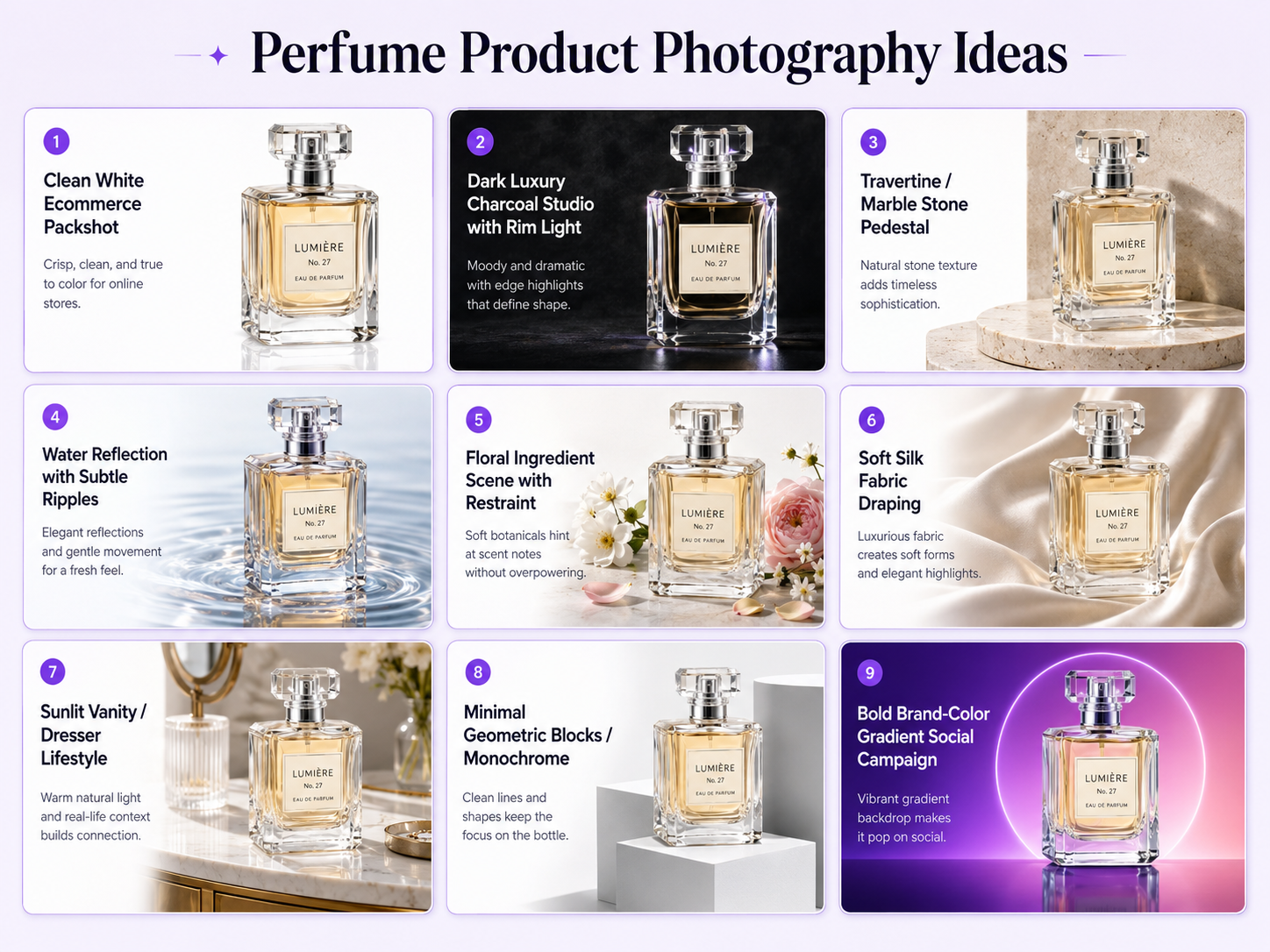
30 Perfume Product Photography Ideas
1. Clean White Ecommerce Background
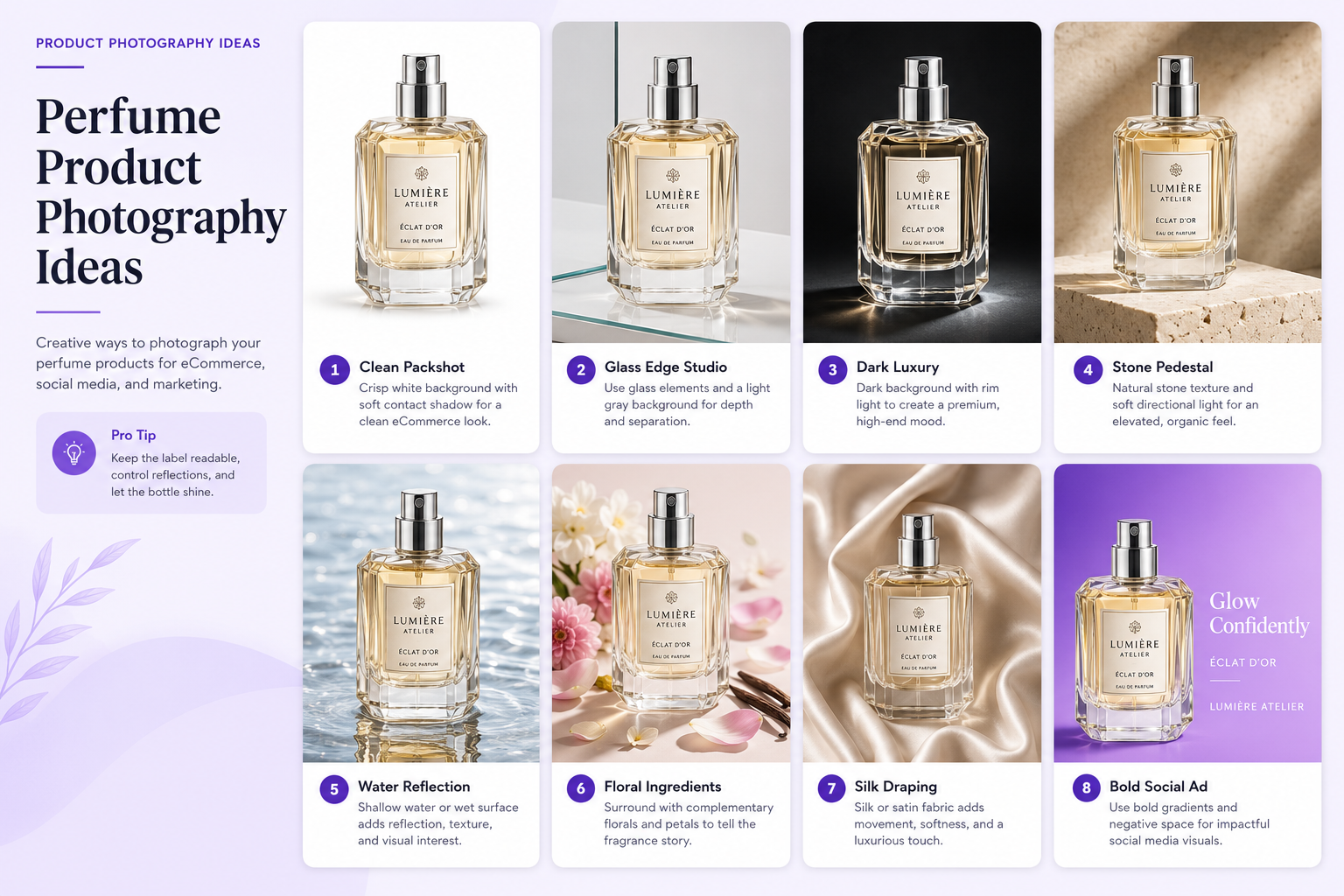
Photograph the bottle against a seamless white background with broad diffused light, clear edges, and a soft realistic contact shadow. This is ideal for product pages, marketplaces, and catalogs.
2. Light Gray Studio
Use a light gray backdrop to create more separation around transparent glass, white labels, silver caps, and pale liquid.
3. Soft Beige Studio
A warm beige or cream background creates an elegant, approachable result for floral, skin-like, powdery, and minimalist fragrances.
4. Dark Luxury Studio
Use a charcoal or black background with controlled rim lighting, subtle reflections, and concentrated highlights. This works well for oud, amber, leather, tobacco, and evening fragrances.
5. Stone Pedestal
Place the bottle on travertine, marble, concrete, or limestone with soft directional light. Keep the pedestal restrained and correctly scaled.
6. Reflective Acrylic Surface
Use a black, white, or tinted reflective surface to create a controlled mirror effect beneath the bottle. Keep the reflection softer and darker than the real product.
7. Water Reflection
Place the bottle near shallow water or a glossy wet surface with subtle ripples and reflected light. This suits fresh, aquatic, mineral, and citrus fragrances.
8. Water Splash
Create a controlled splash around the bottle while keeping the label and cap unobstructed. The water should follow realistic motion and gravity.
9. Floating Droplets
Use restrained droplets around the bottle to suggest freshness. Avoid droplets passing through the glass or covering important text.
10. Floral Ingredient Scene
Arrange a small number of relevant flowers around the bottle. Use only flowers that genuinely match the fragrance story or campaign concept.
11. Citrus Ingredient Scene
Use lemon, bergamot, orange, grapefruit, or peel in a clean arrangement with bright directional light. Keep the bottle as the dominant element.
12. Woody Ingredient Scene
Use cedar, sandalwood, bark, dry leaves, resin, or dark wood in a restrained composition. Warm side lighting can support depth and texture.
13. Vanilla and Amber Scene
Use warm beige, caramel, amber glass, soft shadows, and a small number of vanilla or resin-inspired elements without making the scene look edible.
14. Fabric Draping
Place the perfume on or beside silk, satin, linen, velvet, or chiffon. Use soft folds that frame the product rather than hiding the bottle.
15. Velvet Luxury Setup
Use deep velvet in burgundy, navy, emerald, or black with controlled highlights for an evening or premium fragrance campaign.
16. Minimal Geometric Blocks
Use simple cubes, arches, cylinders, or platforms in a restrained monochrome palette. This works well for modern, architectural, and niche perfume brands.
17. Shadow Pattern Background
Use soft window, leaf, blind, or geometric shadows across a neutral surface. Keep the shadow pattern away from the label.
18. Sunlit Vanity Scene
Place the perfume on a clean vanity with warm daylight, mirror reflections, and minimal beauty accessories. The scene should feel believable rather than overly staged.
19. Bathroom Shelf Lifestyle
Use stone, ceramic, glass, and soft daylight in a refined bathroom setting. Avoid steam or water effects that hide the packaging.
20. Bedroom Dresser Scene
Place the bottle on a tasteful dresser with soft fabric, a mirror, and warm ambient light. Keep personal clutter out of the frame.
21. Hand-Held Perfume Photo
Show a natural hand holding the bottle. Check finger placement, bottle scale, cap, nails, label visibility, and reflections carefully.
22. Fragrance Spray Action
Capture a fine mist leaving the atomizer while preserving the nozzle, cap, bottle shape, and label. The mist should be subtle and physically believable.
23. Macro Bottle Detail
Create a close-up of the cap, atomizer, label texture, embossed logo, beveled glass, liquid line, or decorative element.
24. Packaging and Bottle Pairing
Show the perfume bottle beside its box. Keep both objects accurately scaled and make sure all text, colors, and logos remain unchanged.
25. Multiple Fragrance Lineup
Arrange several bottles or variants in a coordinated row or group. Keep camera height, spacing, scale, and lighting consistent.
26. Seasonal Fragrance Campaign
Use restrained spring flowers, summer light, autumn leaves, winter textures, or holiday materials while keeping the perfume clearly visible.
27. Minimal Brand-Color Gradient
Place the bottle against a clean gradient based on the brand palette with soft shadow and enough negative space for campaign copy.
28. Wide Website Hero
Position the perfume to one side of a wide composition and extend the environment into clean text space for a headline and call to action.
Create a 9:16 composition with the bottle in the lower or center area and generous negative space above for promotional text.
30. Editorial Fragrance Story
Combine the bottle, packaging, selected ingredients, material textures, and directional light to express the fragrance personality in a refined campaign image.
Ideas by Fragrance Style
Fresh and Aquatic
Use pale blue, white, glass, water, droplets, mineral stone, and cool soft light. Keep the liquid and bottle color accurate.
Floral
Use soft fabric, petals, warm daylight, cream backgrounds, and restrained flower arrangements. Avoid covering the label.
Citrus
Use bright natural light, pale stone, clean shadows, and a limited number of citrus ingredients.
Woody
Use dark wood, stone, bark, warm highlights, amber tones, and deeper shadows.
Oriental and Amber
Use velvet, resin-like textures, warm gold, dark backgrounds, and controlled dramatic light.
Minimal and Modern
Use geometric blocks, clean gradients, gray studio, glass, and restrained monochrome styling.
How to Light a Perfume Bottle
- Perfume bottles are difficult because glass reflects the entire environment. Large diffused light sources create cleaner highlights than small direct lights.
- Use side lighting to define the bottle edges and a controlled front fill to keep the label readable.
- A backlight can reveal liquid color and transparency, but it should not overexpose the center of the bottle.
- Move the light, bottle, and camera until highlights describe the glass shape without crossing the logo or label.
Control Reflections and Transparency
Reflections are part of perfume photography, but they should feel intentional.
Use black or white cards outside the frame to shape the edges of clear glass. A dark card creates stronger edge definition, while a white card softens reflections.
Keep mirrors, windows, camera equipment, and the photographer out of the bottle and cap reflections.
When GenImagePro changes the background, inspect the glass carefully. The bottle should reflect the new scene in a way that matches its lighting and color.
Choose the Right Camera Angle
Straight Front View
Best for ecommerce, label visibility, box-and-bottle pairings, and symmetrical bottle designs.
Three-Quarter View
Useful for showing bottle depth, side details, cap shape, glass thickness, and package structure.
Low Angle
Can create a stronger luxury or hero effect, but excessive distortion may enlarge the cap or base.
Overhead
Effective for ingredient flat lays, packaging sets, gift boxes, and multiple fragrance variants.
Macro
Use for labels, embossing, atomizers, glass edges, liquid lines, caps, and material details.
How GenImagePro Fits the Perfume Workflow
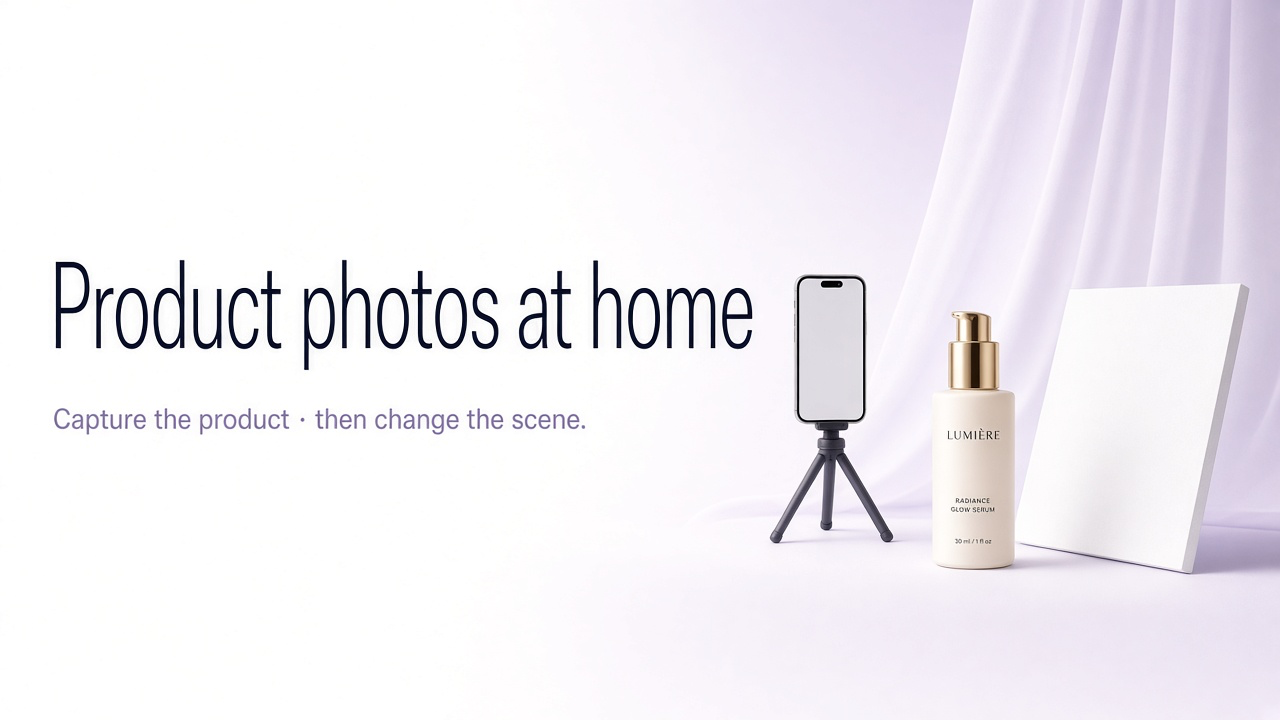
Start with a sharp source image where the entire bottle is visible and the label, cap, glass edges, and liquid level can be inspected.
Choose the closest GenImagePro product-photography template. Useful directions include white studio, stone pedestal, fabric, water, bathroom, home interior, dark premium, and ingredient-based scenes.
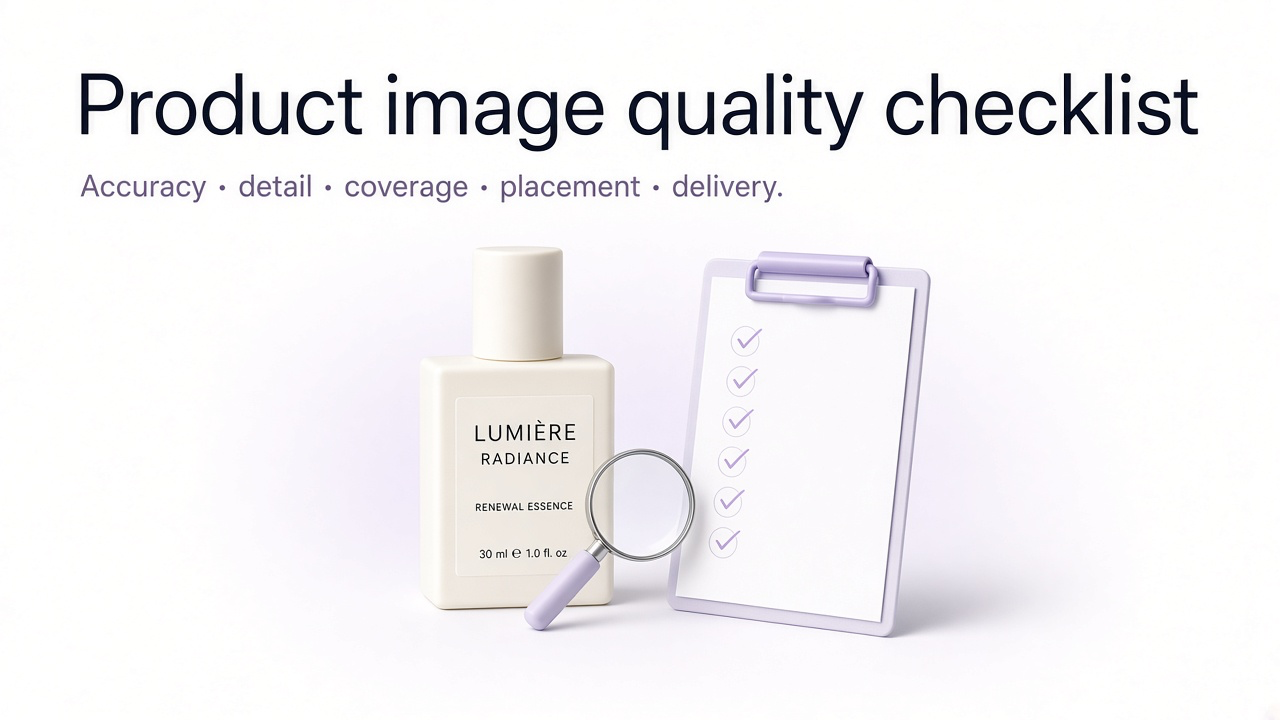
Generate several variations and compare each one with the source. Check the bottle shape, cap, atomizer, logo, typography, label placement, liquid color, fill level, reflections, and proportions.
Use image expansion when you need a wide website hero, vertical social image, or campaign layout with more negative space.
GenImagePro is most effective when the real perfume remains the exact reference and only the presentation changes.
Perfume Photography Prompt Formula
Clean Ecommerce Prompt
Place the uploaded perfume bottle on a white-to-light-gray seamless studio background with broad diffused lighting, clean glass edges, a soft contact shadow, and a centered front-facing composition. Preserve every packaging detail.
Stone Pedestal Prompt
Place the uploaded perfume on a refined travertine pedestal with warm neutral background, soft directional light, subtle shadow, and restrained luxury styling. Keep the exact bottle, cap, label, glass, liquid, and proportions unchanged.
Floral Campaign Prompt
Create a premium floral fragrance campaign with the uploaded perfume as the exact reference, surrounded by a small number of relevant flowers, soft fabric, diffused light, and clean negative space. Do not alter the bottle or add unrelated ingredients.
Dark Luxury Prompt
Place the uploaded perfume in a deep charcoal studio with controlled rim lighting, subtle floor reflection, rich contrast, and a premium editorial composition. Preserve the exact label, cap, glass, liquid, logo, and bottle shape.
What AI Must Preserve
- Bottle silhouette, dimensions, base, shoulders, neck, and glass thickness.
- Cap, atomizer, collar, nozzle, and decorative hardware.
- Logo, label, typography, graphics, batch markings, and package text.
- Glass transparency, tint, reflections, embossing, and material finish.
- Liquid color, opacity, fill level, and internal reflections.
- Box shape, packaging colors, logos, text, and proportions.
- Any visible imperfections or condition details relevant to the real product.
Common Perfume Photography Mistakes
Unreadable Label
Highlights, shadows, condensation, flowers, or props can cover the logo and typography.
Distorted Glass
AI may warp bottle edges, glass thickness, cap proportions, or the atomizer.
Incorrect Liquid Color
Background light and color grading can change the fragrance liquid from pale to dark, warm to cool, or clear to tinted.
Fake Reflections
Reflections may show lights, windows, objects, or colors that do not belong to the scene.
Floating Bottle
Missing contact shadows or incorrect reflections can make the perfume appear disconnected from the surface.
Changed Packaging Text
Small typography, logos, labels, and box text are especially vulnerable to distortion.
Too Many Ingredients
Excessive flowers, fruit, wood, spices, or fabric can hide the bottle and make the scene feel generic.
Perfume Product Photo Checklist
- Confirm that the bottle, cap, atomizer, label, logo, text, colors, and proportions match the real perfume.
- Check glass transparency, liquid color, fill level, reflections, and edge definition.
- Inspect the box and bottle together when packaging is included.
- Make sure ingredients and props are relevant and do not cover important product details.
- Review the image at ecommerce, website, social, and advertising sizes.
Compare every GenImagePro result with the original before publication.
Final Recommendation
The strongest perfume photography combines packaging accuracy with a clear visual mood.
Use clean studio images for ecommerce, ingredient and lifestyle scenes for storytelling, and stronger light, texture, or color for campaigns.
GenImagePro helps turn one real perfume photo into coordinated studio, pedestal, floral, fabric, water, lifestyle, social, and luxury campaign variations. Upload the bottle, choose a template, refine the scene when needed, and confirm that the perfume remains accurate.
FAQ
What is the best background for perfume photography?
White, gray, beige, dark luxury, stone, fabric, water, floral, vanity, and minimal gradient backgrounds can all work.
How do you photograph a clear perfume bottle?
Use large diffused lights, shape the glass edges with black or white cards, control reflections, and add backlight when needed.
How do you keep a perfume label readable?
Move highlights away from the label, use controlled front fill, reduce distracting props, and keep the bottle facing the camera.
What props work for perfume photography?
Stone, flowers, citrus, wood, fabric, water, mirrors, geometric blocks, and packaging can work when they support the real fragrance concept.
Can GenImagePro create perfume product photos?
Yes. GenImagePro can create studio, pedestal, floral, water, fabric, lifestyle, social, and luxury campaign variations from a real perfume photo.
How do I keep perfume packaging accurate with AI?
Preserve the exact bottle, cap, atomizer, logo, label, typography, glass, liquid color, fill level, box, and proportions.
Why do AI perfume photos look fake?
Common causes include warped glass, changed labels, incorrect liquid color, fake reflections, floating bottles, and excessive props.
Does GenImagePro require a perfume prompt?
Not always. GenImagePro provides ready-made product-photography templates, and custom prompts can refine specific campaign scenes.