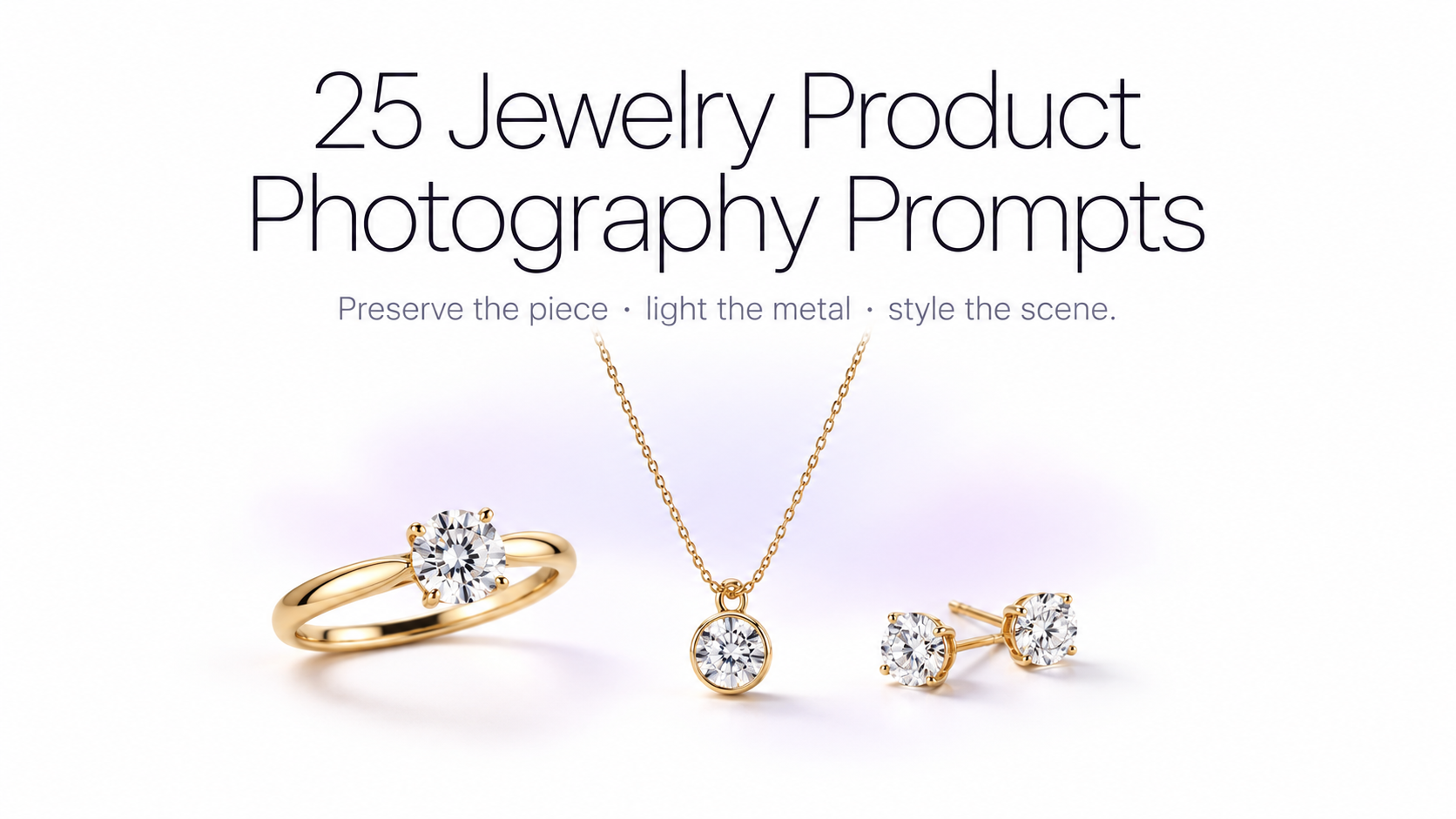
Jewelry is one of the hardest products to photograph well with AI. A successful image has to preserve tiny design details while handling polished metals, gemstones, glass, reflections, chains, clasps, thin edges, and realistic scale.
The prompt therefore needs to do more than ask for a 'luxury jewelry photo.' It should tell the AI what must remain unchanged, how the jewelry should be positioned, what surface or environment surrounds it, how the light interacts with the metal and stones, and what kind of commercial photograph you want.
Below are 25 jewelry product photography prompts covering clean ecommerce images, silk and fabric compositions, stone surfaces, nature-inspired campaigns, water concepts, macro photography, model-worn jewelry, watches, and luxury editorial imagery.
For practical shooting guidance before you generate, see our jewelry photography tips for ecommerce. To compare tools, see the best AI jewelry photography tools. For broader product-prompt structure, start with AI prompts for product photography.
AI jewelry photography templates can turn one clear product photo into white-background listings, luxury studio shots, editorial flat lays, lifestyle scenes, and campaign visuals without writing every prompt from scratch.
Before you start: Keep the jewelry design unchanged
When you are photographing a real product, visual creativity should happen around the jewelry — not to the jewelry itself.
Your prompt should make it clear that the uploaded item is the exact product reference. Preserve its silhouette, dimensions, metal color, construction, stone count, gemstone shape and color, settings, chain structure, clasp, engravings, surface finish, asymmetries, proportions, and any visible branding.
For commercial work, avoid instructions that accidentally encourage the AI to 'improve' the design. Words such as redesign, embellish, enhance the jewelry, add diamonds, or make more luxurious can cause the model to change the actual product.
A simple jewelry photography prompt formula
A reliable structure is: Exact jewelry reference + placement + surface/environment + lighting + camera/composition + material handling + overall photography style.
For example: “Use the uploaded earrings as the exact jewelry product. Preserve their shape, proportions, metal, stones, settings, and construction. Arrange them naturally on softly folded champagne silk. Use diffused directional light from the upper left, controlled silver reflections, crisp gemstone highlights, shallow depth of field, and refined luxury jewelry campaign photography.”
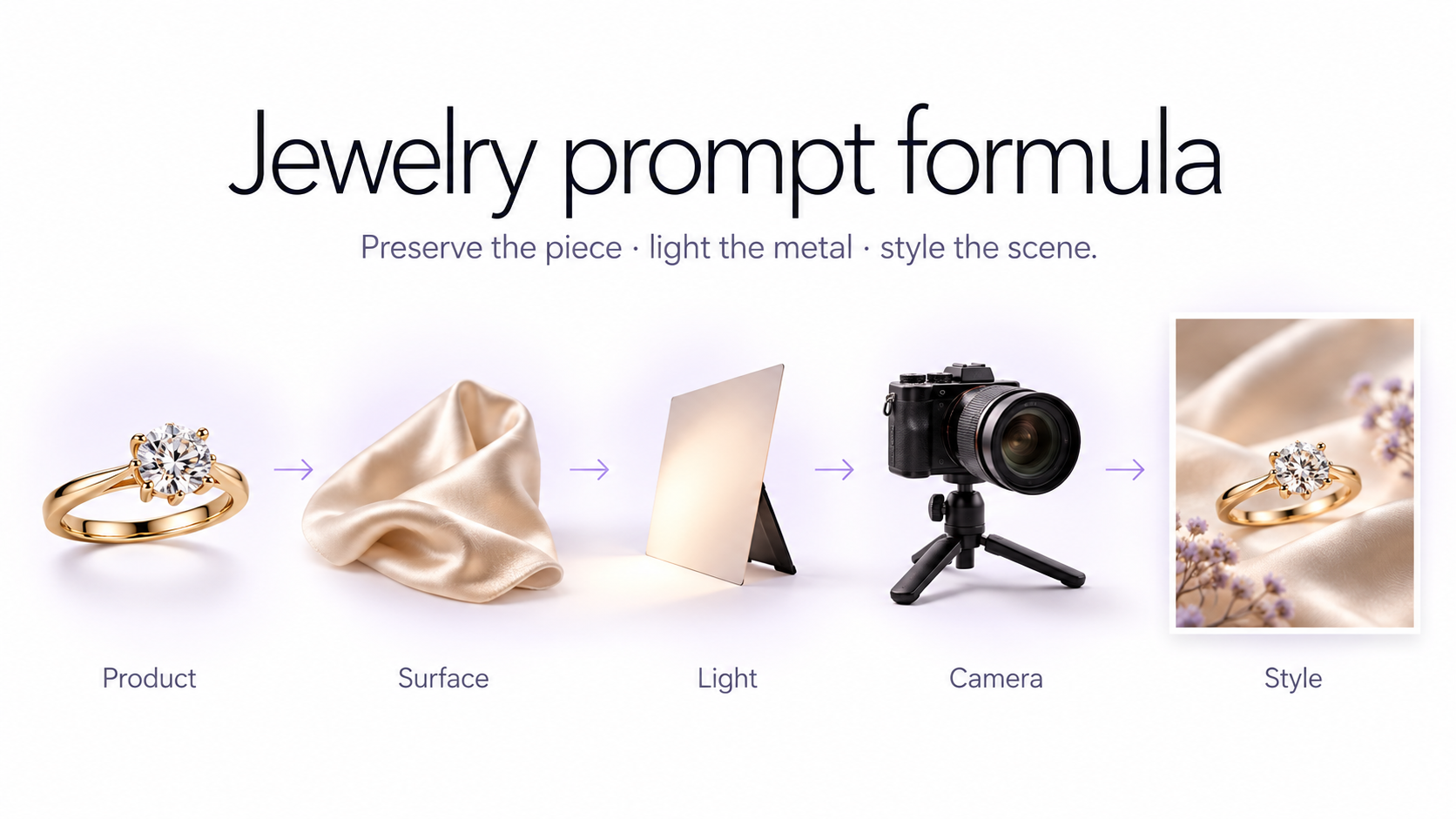
Luxury jewelry product photography prompts
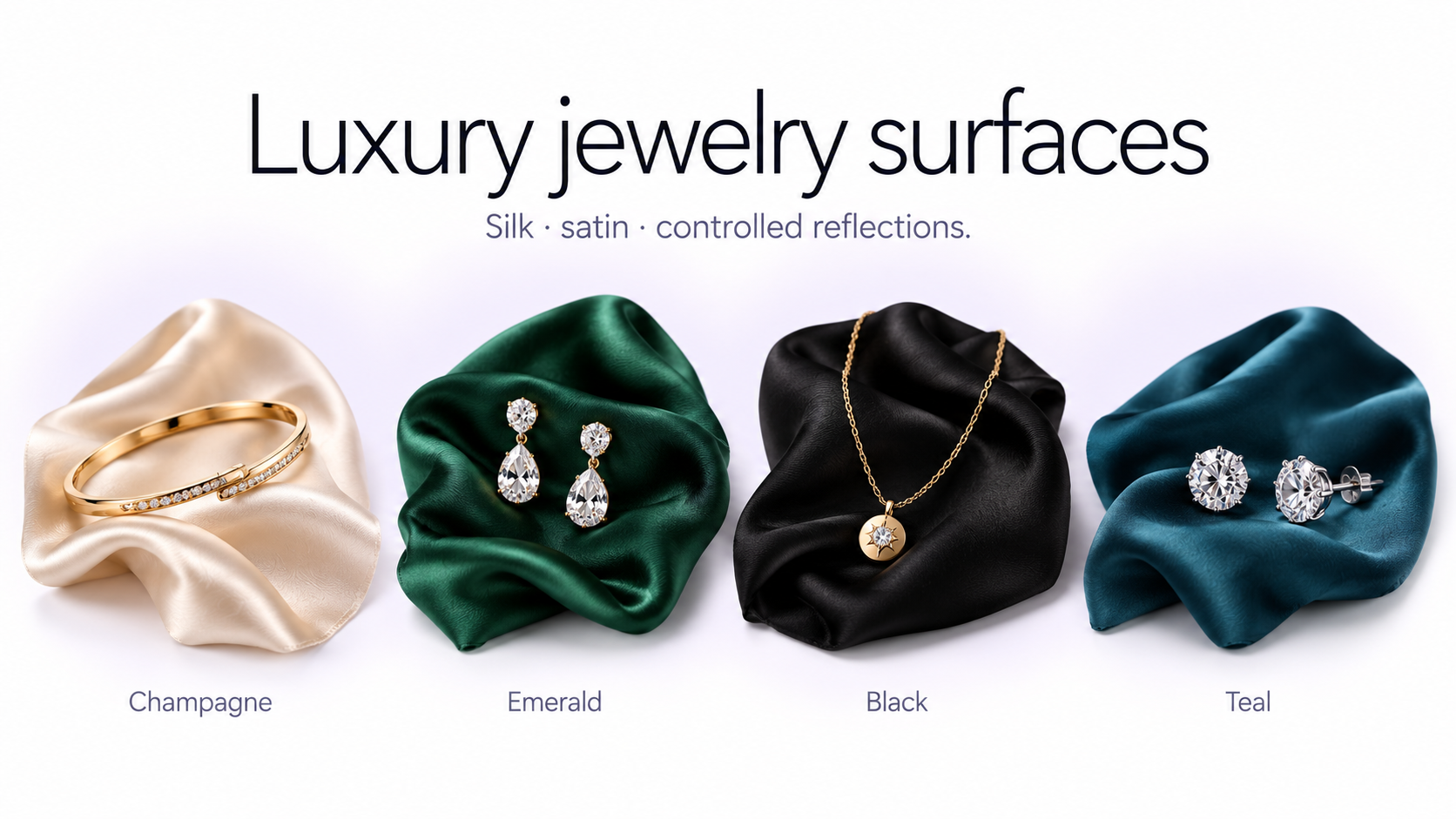
1. Champagne silk jewelry photography
Use the uploaded jewelry as the exact hero product and preserve its original shape, metal color, gemstones, construction, proportions, and all distinctive details. Position the piece naturally on softly folded champagne silk with elegant flowing fabric contours around it. Use warm diffused side lighting that creates gentle highlights across the silk while producing controlled specular reflections on the jewelry. Keep gemstones crisp and luminous without blown highlights. Photograph from a refined slightly elevated angle with shallow depth of field, realistic contact shadows, sophisticated material texture, and premium luxury jewelry campaign photography.
2. Emerald satin luxury campaign
Photograph the uploaded jewelry exactly as provided, preserving every stone, setting, curve, connection, metal finish, and proportion. Place it against deep emerald-green satin with large sculptural folds creating a rich but uncluttered background. Use controlled soft studio light from one side so the fabric falls into deep tonal gradients while the metal catches narrow polished highlights. Keep gemstone colors accurate and detailed. Use a close commercial composition with luxurious contrast, realistic reflections, subtle depth of field, and the visual quality of a premium fine-jewelry advertising campaign.
3. Black silk necklace campaign
Use the uploaded necklace as the exact product reference. Preserve the precise chain structure, links, pendant placement, stones, metal tone, clasp, proportions, and spacing. Arrange the necklace naturally across deep black silk with broad soft folds. Keep the chain following believable gravity rather than floating unnaturally. Use low-key directional studio lighting with delicate golden or silver highlights along the chain and focused sparkle on gemstones. Maintain deep blacks without losing product separation. Elegant fine-jewelry editorial photography, sophisticated, cinematic, realistic, minimal, and highly detailed.
4. Deep teal satin earrings
Create a premium product photograph of the uploaded earrings on deep teal satin. Preserve the earrings exactly, including their silhouette, thickness, curves, metal finish, closures, gemstones, and proportions. Arrange both earrings with natural spacing and matching orientation while allowing the satin to form smooth sculptural folds underneath. Use soft directional light with controlled reflections along the polished metal edges, subtle shadows between the fabric folds, and clean gemstone highlights. Close editorial composition, premium jewelry campaign aesthetic, rich material detail, realistic optics, and no additional jewelry.
Minimal jewelry photography prompts
5. Clean pastel ring photography
Use the uploaded ring as the exact product without changing its design, band thickness, setting, metal color, stone shape, or proportions. Position it upright at a natural three-quarter angle on a minimal pale neutral surface with a softly tinted pastel background. Add one understated natural stone far behind the ring for scale and visual balance. Use clean directional daylight creating a long soft-edged shadow and controlled reflections along the polished metal. Keep the ring tack-sharp with realistic micro-detail while the background falls gently out of focus. Modern premium ecommerce editorial photography.
6. Pure white ecommerce jewelry photo
Create a high-resolution ecommerce photograph of the uploaded jewelry on a pure clean white background. Preserve every physical detail of the real item without redesigning or simplifying it. Center the product with generous breathing room and show its most recognizable commercial viewing angle. Use large diffused studio lighting with clean metal reflections, accurate gemstone color, crisp edges, realistic contact shadow, and no harsh hotspots. Keep the full jewelry piece in sharp focus. Professional catalog photography suitable for ecommerce product pages and marketplace listings.
7. Warm sunlight and shadow
Place the exact uploaded jewelry on a warm ivory or pale sand-colored surface. Preserve all jewelry geometry, stones, colors, and construction. Use strong but refined natural sunlight from the upper side to create an elegant elongated shadow across the scene. Introduce subtle organic window or foliage shadows in the distant background without covering the product. Maintain crisp highlights on polished metal and defined facets on gemstones. Minimal composition, large negative space, realistic afternoon sunlight, sophisticated contemporary jewelry advertising aesthetic.
Stone and natural material jewelry prompts
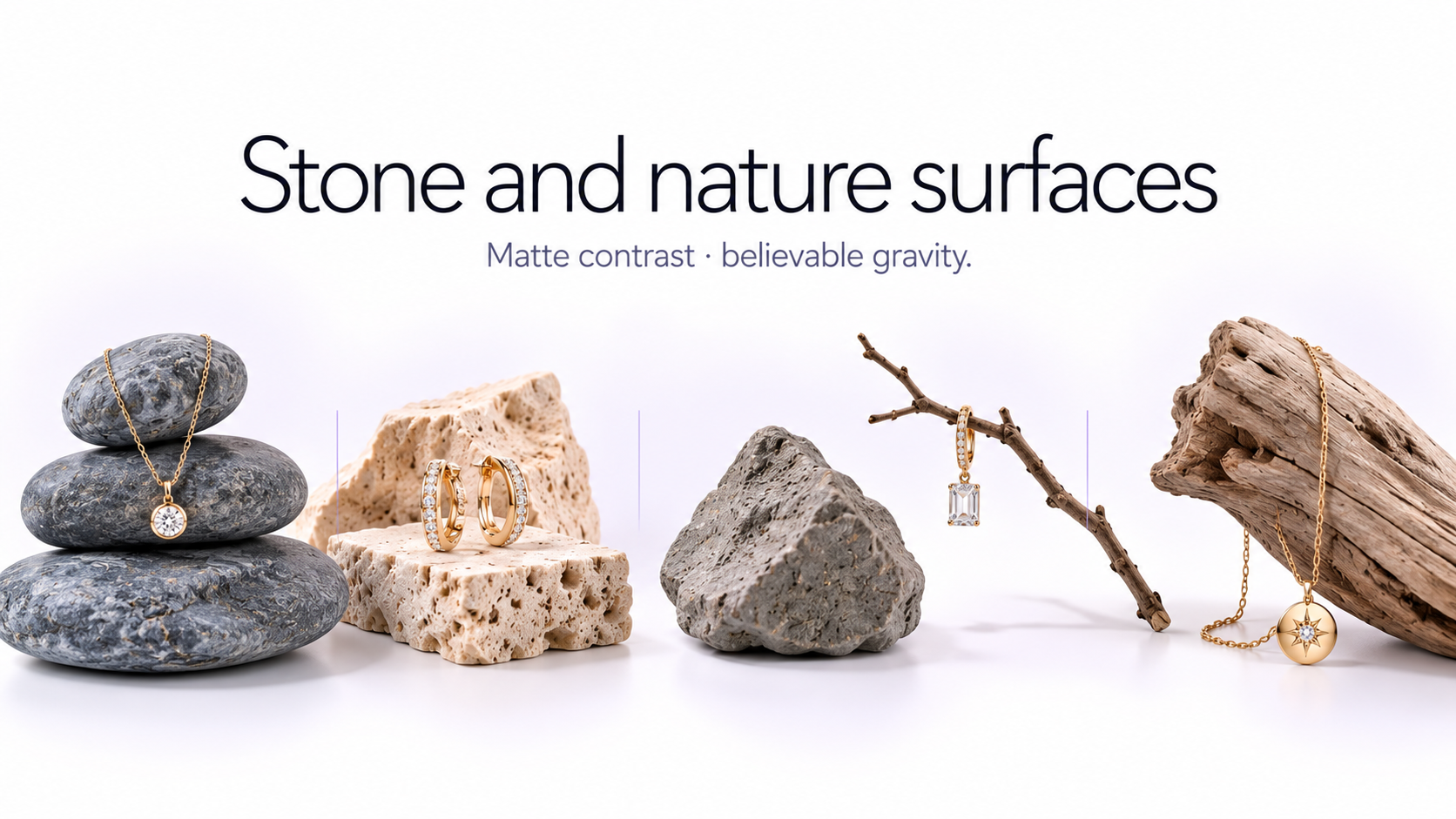
8. Jewelry on stacked blue stone
Use the uploaded necklace as the exact product. Preserve its chain length, pendant placement, stones, colors, links, and all construction details. Style it naturally across two smooth stacked blue-grey stones with subtle organic texture. Let the necklace follow the curvature of the upper stone naturally under gravity. Use soft daylight from the side with delicate metal highlights and small gemstone sparkles. Keep the stones matte so they do not compete with the jewelry. Minimal pale background, refined editorial composition, realistic shadows, quiet luxury jewelry photography.
9. Earrings on sculptural limestone
Photograph the uploaded earrings against warm porous limestone or travertine. Preserve the exact earring shape, stone arrangement, metal finish, scale, and attachment details. Position the pair naturally near the edge of the stone so both pieces remain fully visible. Use warm side lighting that reveals the irregular stone texture while creating crisp controlled highlights through the jewelry. Keep the composition airy and premium with shallow depth of field, understated neutral colors, realistic material contrast, and high-end Mediterranean jewelry campaign photography.
10. Jewelry on sunlit natural rock
Place the uploaded jewelry exactly as supplied on a large naturally textured grey stone. Preserve all design details and product proportions. Use direct natural sunlight filtered through distant foliage to create elegant irregular shadows over the stone while keeping the jewelry itself clearly illuminated. Add a restrained dark-green environmental background with shallow focus. Capture realistic metallic reflections, gemstone brilliance, surface scratches, and natural contact shadows. Sophisticated outdoor jewelry campaign, premium but believable, with no artificial fantasy styling.
Nature-inspired jewelry photography prompts
11. Earrings hanging from a branch
Use the uploaded earrings as the exact product and do not alter their shape, metal, stones, closures, or proportions. Hang each earring naturally from a slender organic tree branch with believable gravity and attachment. Keep the branch minimal and elegant rather than rustic or cluttered. Use a muted olive-grey background with soft directional light from one side, producing polished highlights on the jewelry and a subtle natural shadow from the branch. Shallow depth of field, refined botanical luxury aesthetic, realistic macro product photography.
12. Necklace on weathered driftwood
Drape the exact uploaded necklace naturally over a piece of weathered driftwood. Preserve every link, pendant, stone, clasp, and spacing detail. Let the chain follow the shape of the wood under realistic gravity rather than appearing pasted onto the surface. Use warm soft studio daylight, restrained earthy brown tones, gentle depth of field, and controlled reflections on the metal. The wood should provide tactile contrast without distracting from the jewelry. Premium natural-material jewelry campaign with understated luxury and realistic commercial photography.
Water jewelry photography prompts
13. Gold jewelry on clear blue water
Use the uploaded gold jewelry as the exact product, preserving its curves, dimensions, metal tone, closures, and surface finish. Arrange the pieces on a shallow layer of clear pale-blue water with elegant ripples and small realistic droplets around them. Use bright directional daylight to create clean golden reflections, caustic light patterns through the water, and crisp product edges. Keep the jewelry above or only lightly interacting with the water unless its construction naturally permits otherwise. Fresh luxury campaign aesthetic, sophisticated, glossy, photorealistic, and highly detailed.
14. Underwater silver ring campaign
Create a cinematic underwater product photograph using the uploaded ring as the exact unchanged hero product. Preserve the band, setting, stone, metal color, dimensions, and structural details. Show the ring suspended naturally underwater with a dark mineral riverbed beneath it. Use a burst of water movement and bubbles near the surface above while keeping the ring clearly visible and sharply rendered. Introduce realistic underwater light refraction, cool silver highlights, soft depth falloff, and subtle green-blue tones. Dramatic premium jewelry advertising photography without changing the actual ring design.
15. Jewelry with water splash
Photograph the uploaded jewelry as the exact product within a controlled high-speed water splash composition. Preserve all stones, metal structure, proportions, and closures. Position the jewelry as the visual anchor while a clean arc of water rises around it without obscuring important product details. Use high-speed studio flash, extremely crisp droplets, controlled polished-metal reflections, bright gemstone highlights, and a minimal complementary background. Commercial beauty-campaign precision, realistic physics, premium high-speed product photography, no unnecessary props.
Creative jewelry campaign prompts
16. Sculptural fabric necklace display
Use the uploaded necklace as the exact unchanged jewelry product. Present it suspended naturally between two large sculptural folds of dark navy translucent fabric, creating the impression of an elegant abstract display form rather than a mannequin. Preserve every chain link, pendant, stone, and proportion. Use soft controlled studio lighting with deep blue gradients, narrow metal highlights, precise gemstone sparkle, and subtle separation between the necklace and fabric. Minimal luxury art-direction, sophisticated fine-jewelry advertising, photorealistic materials, no fantasy alteration of the jewelry.
17. Jewelry against blue sky
Use the uploaded earrings as the exact hero products. Preserve their design, scale, metal finish, closure, and all decorative elements. Create a clean conceptual campaign composition against a bright natural blue sky with soft white clouds. Position the earrings prominently with realistic shadows and reflections so they still feel physically photographed rather than floating CGI objects. Use crisp daylight, polished golden or silver highlights, accurate gemstone rendering, strong negative space, and contemporary youthful luxury advertising photography.
18. Ceramic object jewelry campaign
Drape the uploaded necklace naturally around a handmade terracotta ceramic vessel. Preserve the jewelry exactly, including chain length, stone positions, pendant shape, and metal color. Let the necklace respond naturally to the curvature of the vessel with realistic gravity. Use a pale sunlit architectural background with soft organic shadows falling across the wall and ceramic surface. Warm Mediterranean palette, clean daylight, tactile clay texture, refined metal highlights, generous negative space, and sophisticated lifestyle jewelry campaign photography.
Macro jewelry photography prompts
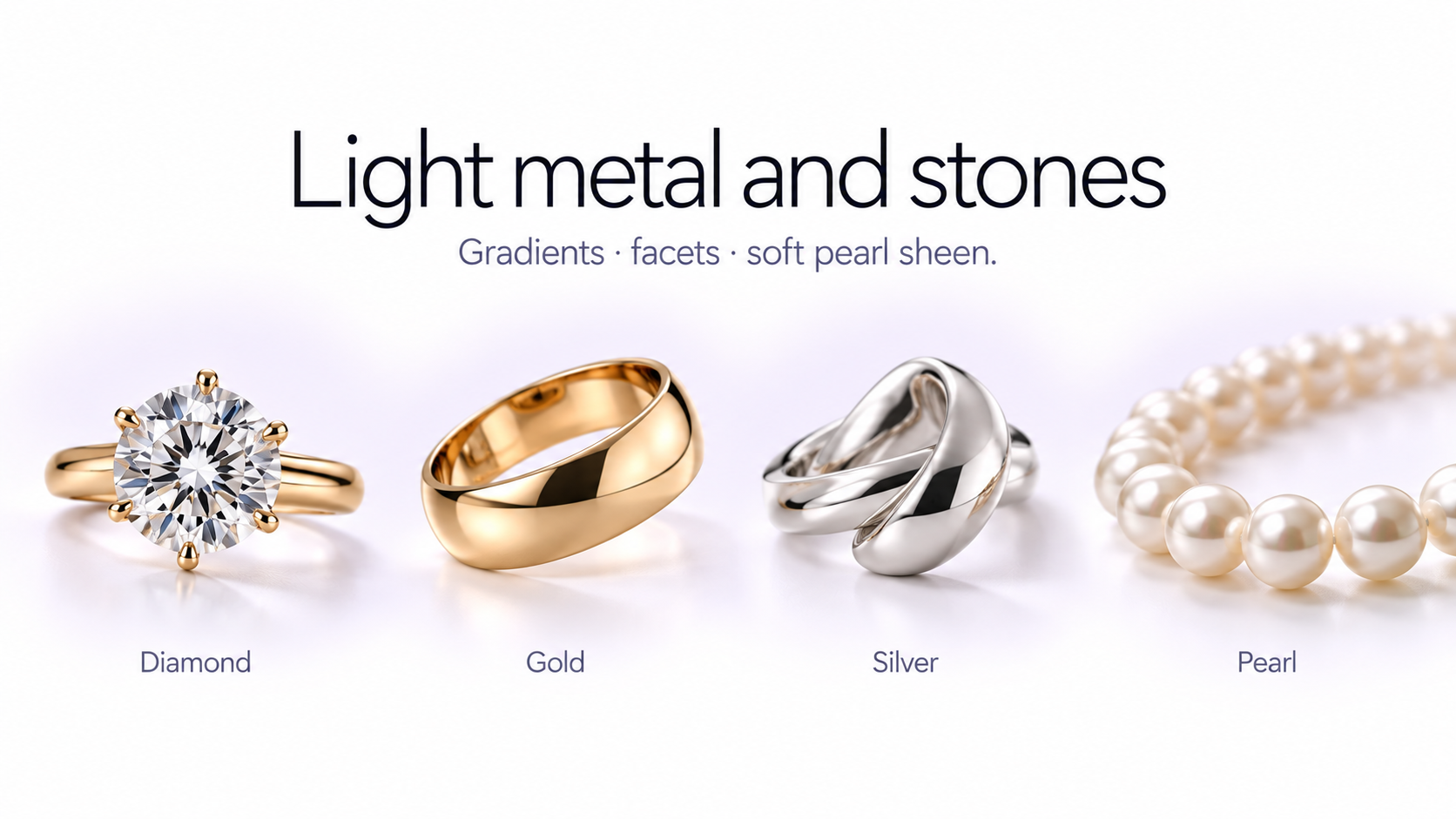
19. Diamond macro photography
Create an extreme macro photograph of the uploaded diamond jewelry while preserving the exact setting, stone cut, prongs, dimensions, metal finish, and design. Focus precisely on the main gemstone and adjacent setting details. Use controlled multi-source jewelry lighting that reveals individual facets without producing blown white reflections. Show realistic dispersion and subtle spectral highlights rather than exaggerated rainbow effects. Capture microscopic metal texture, polished edges, accurate gemstone transparency, shallow but deliberate depth of field, and premium professional jewelry macro photography.
20. Polished gold macro photography
Use the uploaded gold jewelry exactly as provided. Create a close macro product photograph emphasizing its sculptural form and polished surface. Use large diffused light sources positioned to create smooth continuous highlight gradients along the gold instead of random bright hotspots. Preserve the exact warm metal tone and avoid making the piece overly yellow or orange. Show subtle realistic surface detail, crisp edges, controlled shadow transitions, and premium commercial jewelry photography with a minimal neutral background.
21. Silver jewelry macro photography
Create a detailed macro photograph of the exact uploaded silver jewelry. Preserve its geometry, finish, stones, joins, and construction. Use broad diffused studio panels so the silver reflects elegant white-to-grey gradients rather than becoming flat white or black. Maintain realistic cool metallic character, precise edge definition, subtle microtexture, clean gemstone reflections where present, and carefully controlled contrast. Minimal pale grey environment, high-end catalog photography, technically clean and photorealistic.
22. Pearl jewelry photography
Use the uploaded pearl jewelry as the exact product and preserve the pearl count, size, spacing, shape, color, setting, chain, and clasp. Photograph it against soft ivory silk with large gentle folds. Use broad diffused lighting that reveals the natural pearlescent luster through soft layered reflections rather than harsh white spots. Maintain delicate cream, blush, and silver tonal variation within the pearls. Elegant close composition, realistic scale, subtle shadows, refined bridal-luxury aesthetic, and premium editorial product photography.
Model-worn jewelry photography prompts
23. Ring on hand
Use the uploaded ring as the exact jewelry product and preserve its design, metal, setting, gemstone, proportions, and scale. Place it naturally on the appropriate finger of an adult model's hand. Ensure realistic ring sizing and physical contact with the finger. Use clean natural skin texture, understated nails, a neutral pale background, and soft diffused daylight. Keep the ring as the sharpest visual element while preserving realistic hand anatomy. Modern ecommerce and lifestyle jewelry photography, elegant and commercially believable.
24. Earrings in an editorial portrait
Use the uploaded earrings as the exact products without redesigning their shape, stones, metal, closure, or proportions. Place them naturally on an adult fashion model and maintain believable scale relative to the ears and face. Create an understated luxury editorial portrait with pulled-back hair so the earrings remain clearly visible. Use soft directional daylight, realistic skin texture, subtle makeup, controlled highlights on the jewelry, and shallow depth of field. Sophisticated fashion campaign photography with the earrings remaining the visual focus.
25. Necklace in a refined lifestyle scene
Use the uploaded necklace as the exact product and preserve its complete chain, pendant, stones, color, length, proportions, and construction. Place it naturally around an adult model's neck with realistic chain tension and pendant placement. Style the model in a simple neutral garment with an open neckline that does not compete with the jewelry. Use soft window light, restrained styling, natural skin texture, gentle shadows, and a premium lifestyle setting. Keep the necklace crisp and recognizable while the environment remains subtly out of focus.
Bonus: Luxury watch photography prompt
Use the uploaded watch as the exact product and preserve the case shape, dial design, hands, markers, crown, bracelet or strap, materials, branding, glass, proportions, and construction. Position it at a refined three-quarter angle on a dark matte stone surface. Use large controlled strip lights to define the case edges and polished metal while maintaining visibility through the watch crystal without excessive glare. Keep the dial sharply legible, bracelet links realistic, shadows clean, and materials physically accurate. Premium Swiss-style commercial watch photography, restrained, architectural, and highly detailed.
How to photograph reflective jewelry with AI
Reflective materials are where jewelry prompts benefit most from photographic language.
For polished gold, ask for broad controlled reflection gradients rather than simply 'bright lighting.' Gold should retain a believable warm metallic tone rather than becoming flat yellow.
For silver and white gold, use large diffused sources that produce clean white and grey reflections. Without environmental reflections, polished silver can look like matte plastic.
For diamonds and transparent gemstones, ask for crisp facet definition, controlled specular highlights, transparency, refraction, and restrained dispersion. Excessive sparkle can quickly make stones look artificial.
For pearls, use broad soft lighting. Their appearance comes from gradual layered reflections rather than sharp mirror-like highlights.
Background choice also changes how metal reads. For surface ideas beyond jewelry-specific setups, see our guides to product photography backgrounds and lifestyle product photography.
How to keep jewelry accurate in AI product photos
The smaller and more detailed the product, the easier it is for a generative model to reinterpret it. Jewelry therefore benefits from explicit preservation instructions.
Tell the model to preserve the exact stone count, stone placement, prongs, chain links, metal color, thickness, proportions, closures, engravings, and asymmetrical design details.
This is especially important for pairs of earrings. The AI should use the uploaded pair as the reference rather than inventing a second complementary design.
For necklaces and bracelets, also pay attention to gravity. Chains should drape over surfaces naturally rather than remaining unnaturally stiff or forming impossible curves.
You do not always need to write a jewelry photography prompt
Writing a detailed prompt is useful when you want complete control over the art direction. But if you already know the visual style you want, starting from a purpose-built photography template can be significantly faster.
GenImagePro includes dedicated AI jewelry photography templates. Upload your ring, necklace, earrings, bracelet, watch, or other jewelry product and choose a ready-made jewelry composition instead of describing the entire setup from scratch.
The available directions include clean white-background ecommerce shots, luxury studio scenes, editorial flat lays, lifestyle and creative compositions, and premium product visuals. You can also generate fabric, stone, water, and model-worn concepts with prompts when you need a more specific art direction.
You can use a template to establish the first image and then continue editing the result if you want to change details such as the lighting, surface, surrounding props, composition, or overall atmosphere. For related product and fashion prompt libraries, see fashion product photography prompts and the lifestyle product photo generator.
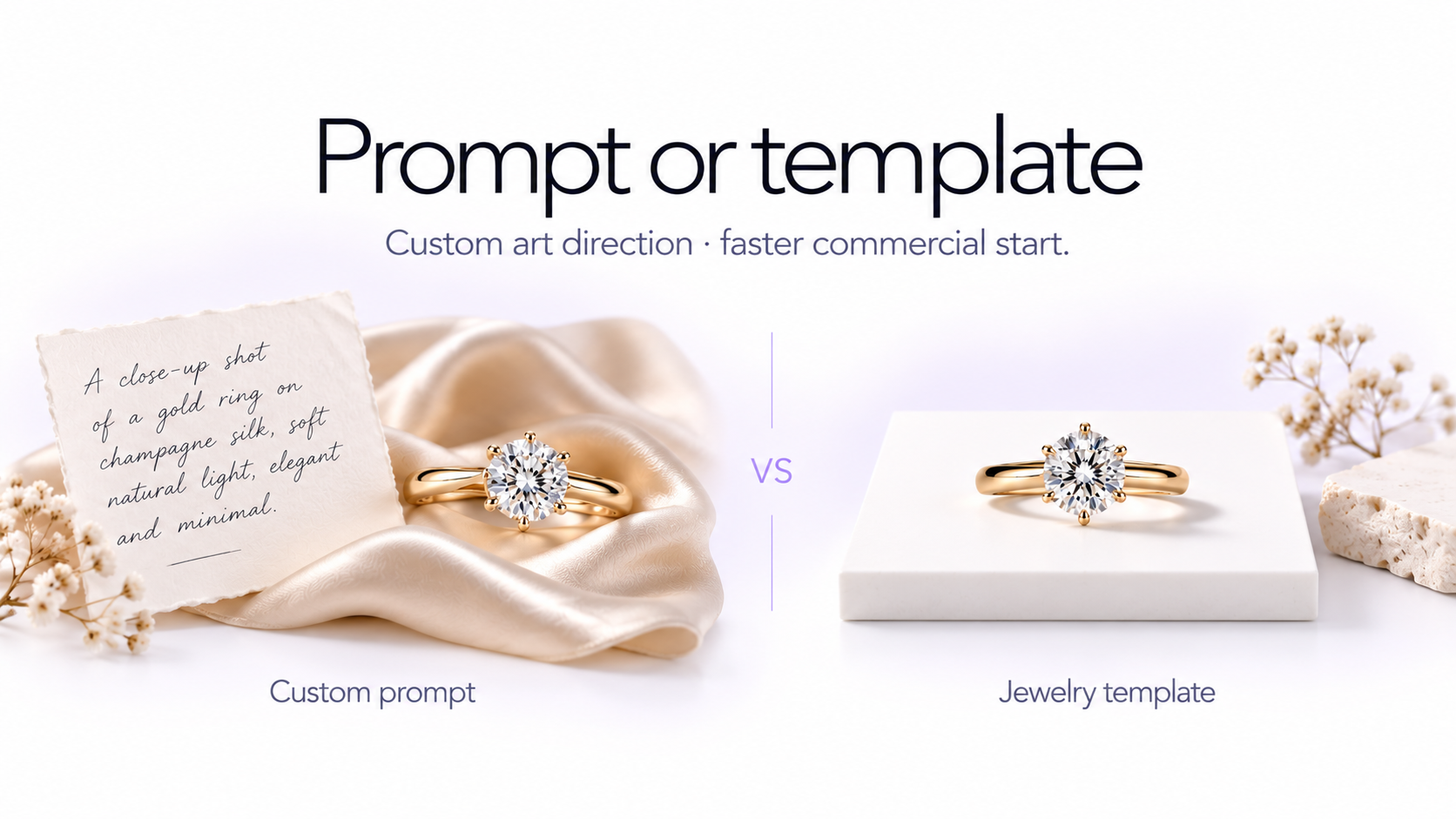
Prompt or jewelry template: Which should you use?
Use a prompt when you already have a very specific creative concept. Use a jewelry template when you want a polished commercial direction without having to describe the photography setup yourself.
A practical workflow is to start with a jewelry template, generate the initial product photo, and then refine it conversationally. For example: “Make the silk slightly warmer,” “Use softer light,” “Move the earrings farther apart,” or “Keep the jewelry unchanged and make the background darker.”
Common mistakes in AI jewelry photography
The most common mistake is describing the mood extensively while barely describing product preservation. A beautiful photograph is not commercially useful if the AI changes the ring setting or adds another gemstone.
Another mistake is asking for too many decorative props. Jewelry is physically small, so complicated environments can easily overwhelm it. Strong jewelry photography usually has one dominant product, one clear surface or visual idea, deliberate lighting, and enough negative space around the piece.
Avoid generic instructions such as 'make it luxurious' without explaining the photography. Luxury can come from controlled reflections, tactile materials, restrained composition, carefully shaped light, realistic shadow, strong macro detail, and intentional color relationships.
Frequently Asked Questions
What is a good prompt for jewelry photography?
A strong jewelry photography prompt identifies the uploaded jewelry as the exact product, explains how it should be positioned, specifies the surface or environment, describes the lighting and reflections, and defines the photographic style. It should also explicitly state which jewelry details must remain unchanged.
How do I make AI jewelry photos look realistic?
Focus on material behavior. Metal needs controlled environmental reflections, gemstones need realistic facet highlights and refraction, chains need believable gravity, and the jewelry needs a natural contact point or physical interaction with the scene.
How do I stop AI from changing my jewelry design?
Tell the model to use the uploaded jewelry as the exact product reference and preserve its shape, proportions, metal color, gemstones, stone count, stone placement, settings, links, clasps, engravings, and other distinctive construction details.
What background is best for jewelry photography?
There is no single best background. Pure white works well for ecommerce, silk and satin create a luxury campaign feel, stone adds tactile contrast, dark backgrounds emphasize bright metals and gemstones, and minimal natural environments work well for lifestyle campaigns.
How should I photograph gold jewelry with AI?
Use broad diffused lights that produce controlled highlight gradients along the metal. Ask the AI to preserve the natural gold tone and avoid excessive yellow saturation or hard white hotspots.
How should I photograph silver jewelry with AI?
Silver needs an environment to reflect. Broad white and grey light sources help define its polished shape. Avoid completely flat lighting, which can make reflective silver appear white, grey, or plastic.
Can AI create jewelry photos with models?
Yes. AI can place rings on hands, earrings on models, necklaces around the neck, and bracelets on wrists. Prompts should specify realistic product scale, physical placement, natural anatomy, and preservation of the exact jewelry design.
Do I need prompts to create AI jewelry product photos?
No. In GenImagePro, open AI jewelry photography, upload your product, and choose a ready-made jewelry photography template. Prompts are useful when you want a more custom scene or art direction.