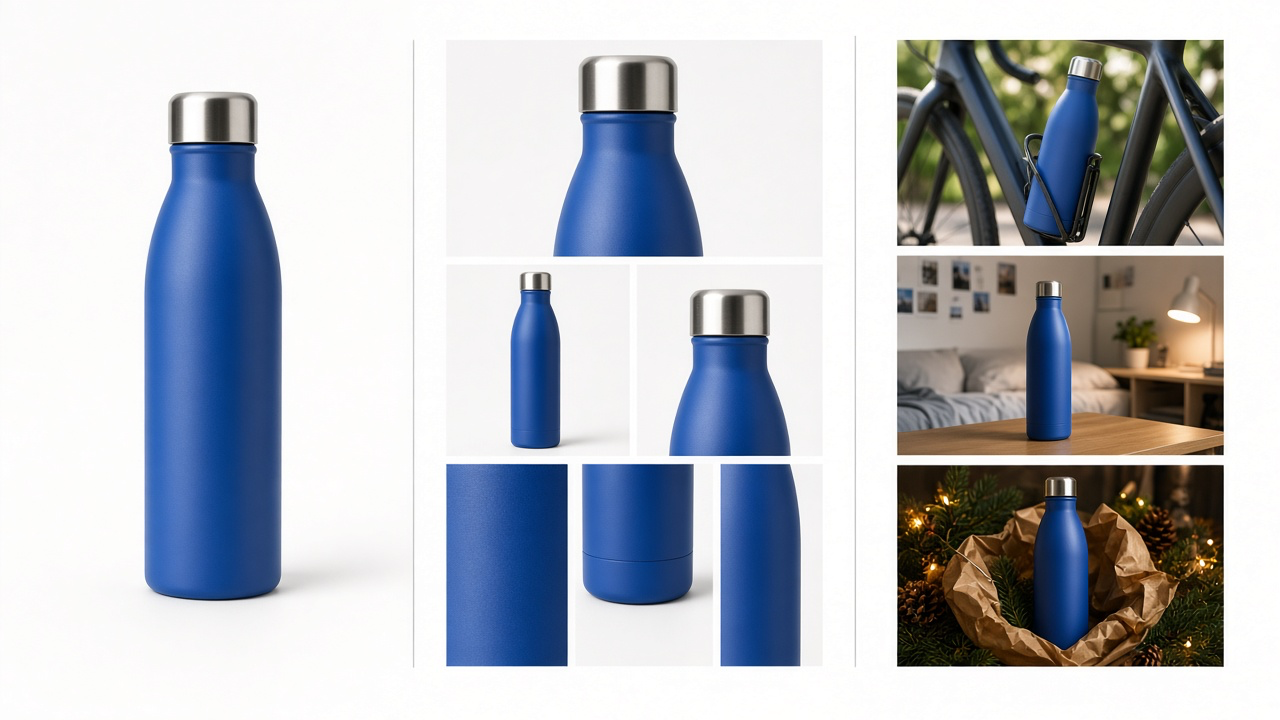
One product. Twelve months. Twelve reasons to pay attention. Seasonal advertising is not about putting snowflakes on a product in December and palm trees behind it in June. It is about showing the same product fitting into different moments in a customer’s life.
This practical US seasonal creative calendar uses one insulated water bottle as a running example, but the framework works for apparel, beauty, accessories, home goods and consumer electronics. Use source photographs to anchor product fidelity, then develop new people, locations, narratives and formats for the moment being marketed. Pair this calendar with concept-led Meta creative diversity so seasonal ads stay distinct ideas, not color swaps.
Why a seasonal creative calendar works
Customer context changes even when your product does not. A reusable water bottle can be a January habit tool, an August school essential, and a November gift. The object is stable; the audience motivation and visual story change. That gives your creative team a repeatable planning system without requiring a new full-day shoot for every promotional window.
The National Retail Federation defines the winter holiday shopping season as November 1 through December 31, while many shoppers begin earlier. Back-to-school shopping can also start well before August, so creative production should happen ahead of the event rather than on the event date. Sources: NRF winter holiday FAQs and EMARKETER back-to-school timing.
The 12-month US seasonal campaign calendar
| Month | US shopping moment | Creative concept | Suggested production lead |
|---|---|---|---|
| January | New Year, fresh routines | A morning reset | mid-December |
| February | Winter escapes and thoughtful gifts | The cabin weekend | early January |
| March | Spring reset | The first outdoor day | early February |
| April | Earth Month and everyday reuse | The refill moment | early March |
| May | Graduations and travel preparation | The new chapter | early April |
| June | Summer travel and outdoor weekends | The road trip | early May |
| July | Summer heat, picnic days, Independence Day | The park picnic | early June |
| August | Back-to-school and campus move-in | The backpack check | June–July for early shoppers |
| September | Fall routines and work resets | The desk-to-trail switch | early August |
| October | Autumn weekend and Halloween | The cinematic night walk | early September |
| November | Holiday gifting and Black Friday | The gift decision | October or earlier |
| December | Winter holidays and year-end gifting | The gift under the tree | early November |
Illustrative calendar, not universal launch dates; adjust timing to category, inventory, target audience and previous campaign performance.
January through December: the creative concepts
01. January: A morning reset
Seasonal hook: New Year, fresh routines. Audience: New-year routine shoppers. Format: 4:5 lifestyle / 9:16 routine reel. Prepare by: mid-December. Build the ad around “a morning reset” rather than adding seasonal decoration to the same old packshot.

02. February: The cabin weekend
Seasonal hook: Winter escapes and thoughtful gifts. Audience: Gift seekers and winter travelers. Format: 4:5 social / 1:1 product+gift set. Prepare by: early January. Build the ad around “the cabin weekend” rather than adding seasonal decoration to the same old packshot.

03. March: The first outdoor day
Seasonal hook: Spring reset. Audience: Outdoor returners. Format: 9:16 motion storyboard / 4:5 still. Prepare by: early February. Build the ad around “the first outdoor day” rather than adding seasonal decoration to the same old packshot.

04. April: The refill moment
Seasonal hook: Earth Month and everyday reuse. Audience: Sustainability-minded shoppers. Format: 4:5 documentary still / 9:16 loop. Prepare by: early March. Build the ad around “the refill moment” rather than adding seasonal decoration to the same old packshot.

05. May: The new chapter
Seasonal hook: Graduations and travel preparation. Audience: Graduates and gift buyers. Format: 4:5 portrait / carousel. Prepare by: early April. Build the ad around “the new chapter” rather than adding seasonal decoration to the same old packshot.

06. June: The road trip
Seasonal hook: Summer travel and outdoor weekends. Audience: Road-trippers. Format: 16:9 hero / 9:16 short video. Prepare by: early May. Build the ad around “the road trip” rather than adding seasonal decoration to the same old packshot.

07. July: The park picnic
Seasonal hook: Summer heat, picnic days, Independence Day. Audience: Summer outing shoppers. Format: 1:1 still / 4:5 feed. Prepare by: early June. Build the ad around “the park picnic” rather than adding seasonal decoration to the same old packshot.

08. August: The backpack check
Seasonal hook: Back-to-school and campus move-in. Audience: Students and parents. Format: 9:16 vertical UGC / 4:5 still. Prepare by: June–July for early shoppers. Build the ad around “the backpack check” rather than adding seasonal decoration to the same old packshot.

09. September: The desk-to-trail switch
Seasonal hook: Fall routines and work resets. Audience: Professionals reestablishing habits. Format: 4:5 editorial / 9:16 transition video. Prepare by: early August. Build the ad around “the desk-to-trail switch” rather than adding seasonal decoration to the same old packshot.

10. October: The cinematic night walk
Seasonal hook: Autumn weekend and Halloween. Audience: Seasonal lifestyle shoppers. Format: 9:16 cinematic / 4:5 still. Prepare by: early September. Build the ad around “the cinematic night walk” rather than adding seasonal decoration to the same old packshot.

11. November: The gift decision
Seasonal hook: Holiday gifting and Black Friday. Audience: Deal and gift shoppers. Format: 4:5 gift guide / 1:1 catalog tile. Prepare by: October or earlier. Build the ad around “the gift decision” rather than adding seasonal decoration to the same old packshot.

12. December: The gift under the tree
Seasonal hook: Winter holidays and year-end gifting. Audience: Last-minute gift buyers. Format: 4:5 story / 9:16 reel. Prepare by: early November. Build the ad around “the gift under the tree” rather than adding seasonal decoration to the same old packshot.

Not every product belongs in every holiday
A calendar is a planning tool, not a demand to force twelve promotions. For skincare, graduation may be less relevant than Mother’s Day; for apparel, spring transition and fall layering may matter more than Earth Month. Replace weak moments with category-relevant occasions, and avoid culturally insensitive or opportunistic treatment of observances such as Juneteenth, Memorial Day, or Veterans Day.
How to make 12 campaigns from the photos you already have
A practical six-step production workflow
Select accurate product reference images
Gather clear front, side and detail photos, with accurate packaging, color and proportions. Photograph hidden sides or labels if a campaign needs them; AI should not invent missing facts.
Create a product-fidelity brief
Write down details that may never change: bottle shape, dimensions, cap, surface finish, labeling and real capabilities. For clothing, document fabric, fit and construction.
Map the moments that matter
Choose genuinely relevant seasonal needs and purchase motivations for your audience. Research search behavior, sales history, inventory timing and local school calendars.
Write twelve distinct creative briefs
Specify audience, emotional hook, story, setting, talent, camera treatment, visual format and CTA. If two briefs read almost identically, rethink one.
Generate and refine in GenImagePro
Use your product image references to explore seasonal product, lifestyle, fashion, ecommerce and conceptual campaign directions. Validate recognizable product details in every generated image.
Build format families and test
Adapt strong concepts into 1:1 catalog tiles, 4:5 feed images, 9:16 vertical storyboards or videos. Check performance by audience and creative concept, not merely by colorway.

Three mistakes that make seasonal creatives feel generic
Only changing the background: A snow texture and a summer gradient are seasonal skins, not different reasons to buy. Starting too late: Back-to-school and holiday discovery windows can precede the actual occasion by weeks or months. Losing product accuracy: Never allow a generated campaign to change the label, color, size, features or claims of the item you sell.
Measure concept performance, not the number of exports
Track campaign performance by seasonal story, audience and format. Use a consistent naming system such as AUG_BTS_DORM_UGC_9x16, and review click-through rate, conversion rate, cost per acquisition and return on ad spend with enough volume to interpret responsibly. Avoid attributing a win to creative if audience, offer and budget changed simultaneously.
Seasonal AI advertising: FAQs
Can I use one product photo to create seasonal campaign visuals?
You can start with one clear reference, but multiple angles and detail images improve the ability to preserve product accuracy. Review generated outputs carefully.
When should I start making back-to-school ads?
For many US categories, planning and creative production should begin in June or July rather than waiting until August. Exact timing depends on the customer segment and category.
When should holiday creative be ready?
Prepare holiday concepts in advance of the November–December retail period. Some brands start awareness and gift discovery in October or earlier.
Does every month need a holiday sale?
No. Seasonal campaigns can reflect life moments, weather, routines and cultural context without offering discounts.
What makes two seasonal ads genuinely different?
A new audience situation, customer motivation, story, visual language or format. Simply swapping colors or holiday props is usually a minor executional variation.
Can AI create realistic people using my product?
It can produce lifestyle concepts, but ensure interactions and product features are truthful, consent rights are respected, and no person or endorsement is misrepresented.
Which aspect ratios should I prepare?
Common starting points include 1:1, 4:5, 9:16 and 16:9. Confirm current ad placement specifications before exporting.
Is this calendar only for skincare or water bottles?
No. Replace the illustrated water bottle with your own product and choose seasonal stories that match your actual buyers.
Sources and planning references: US OPM federal holiday calendar; NRF winter holiday definitions; EMARKETER back-to-school timing guidance. Holiday dates vary by year; this is a reusable editorial calendar rather than a fixed-date 2026 list.