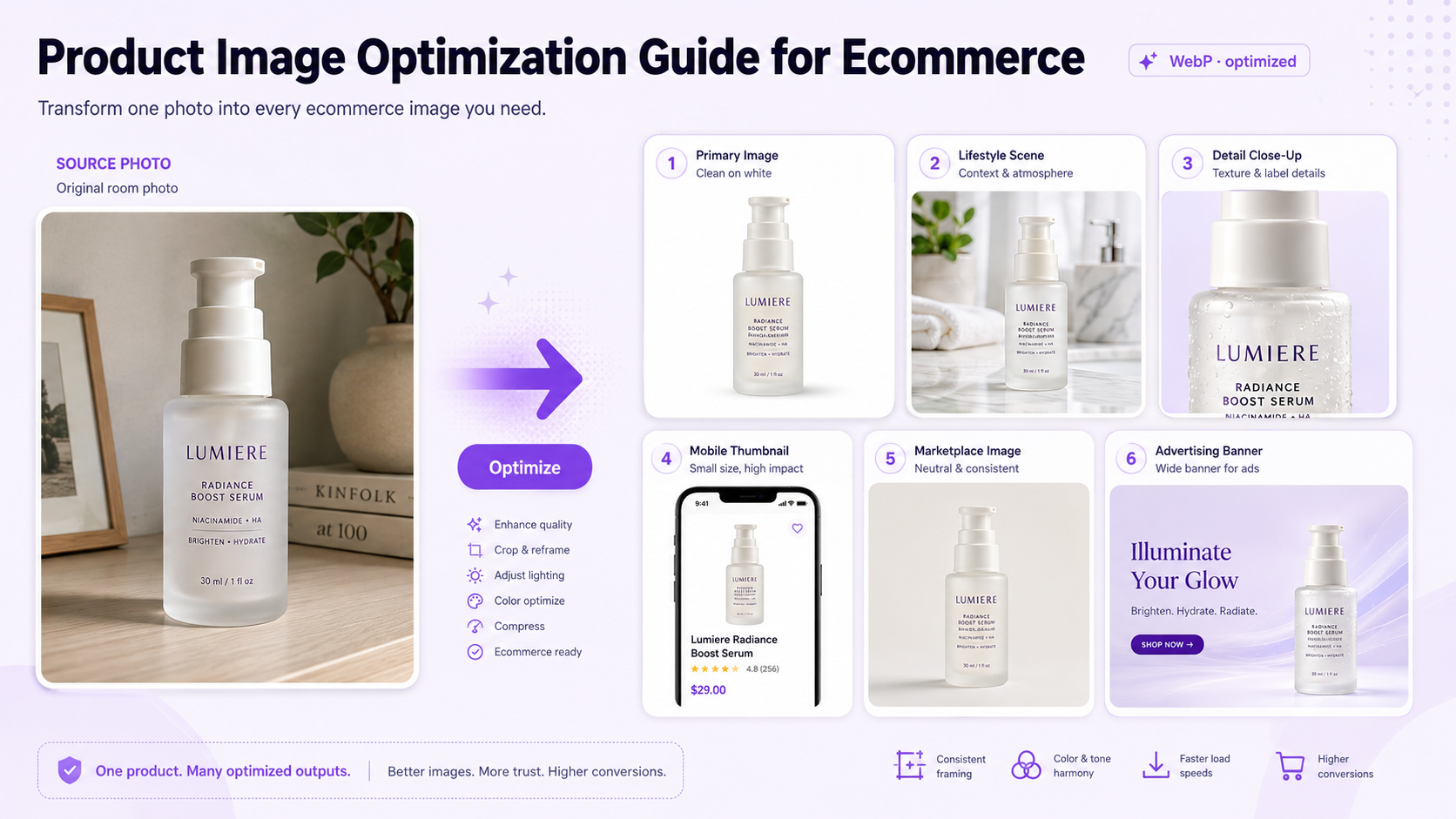
The internet has a new reflex: see a glossy, unusually perfect advertisement and ask, “Is this AI?” Sometimes the suspicion is correct. Sometimes it is not. Either way, it changes the way people look at the brand behind the image.
For marketers, ecommerce sellers, and creative teams, this raises a more useful question than whether AI ads are good or bad: what makes an AI-assisted advertisement worth trusting? Recent US research offers a surprisingly nuanced answer. Consumers do not treat every use of generative AI as equivalent, and the appearance of an ad is not a reliable guide to how it was produced.
The distinction matters when a brand uses AI to imagine a striking product world, generate campaign variations, build video concepts, or scale visual production. Creative freedom is valuable. Misrepresenting the thing a customer will receive is not.
What Americans actually think about AI ads
In the August 2026 Bentley University–Gallup Business in Society survey, 49% of US adults viewed businesses using AI to create advertisements negatively; 19% viewed it positively, and 32% were neutral. The same study found 79% reported seeing ads in the previous month that looked AI-made. That final measure reflects what respondents thought they saw, not an audit proving which ads were generated with AI. Source: Bentley University–Gallup survey
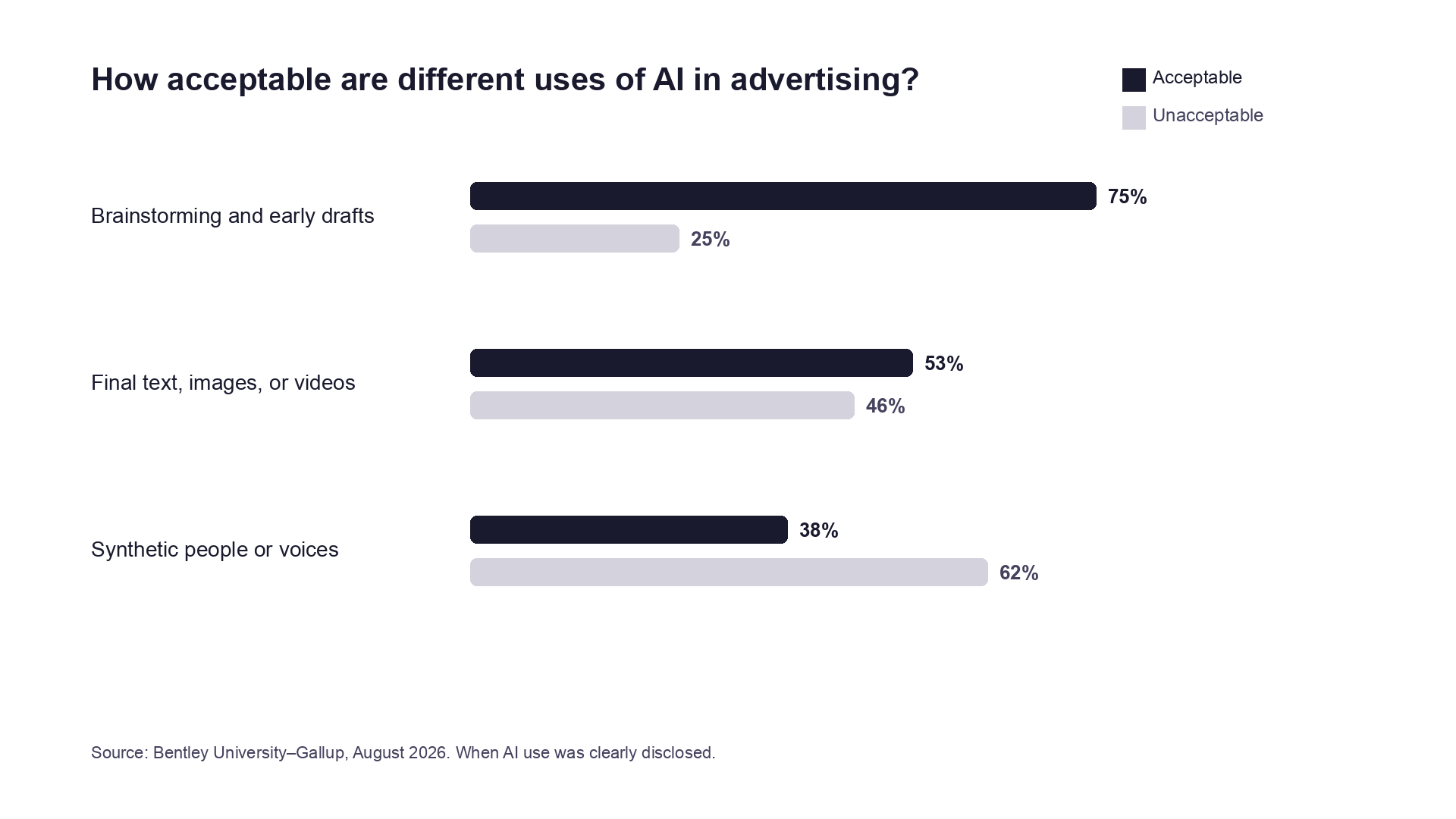
The same Gallup survey reveals why a single “consumers hate AI” headline misses the point. When AI use was clearly disclosed, 75% considered using AI for brainstorming or early ad drafts acceptable. Acceptance fell to 53% when AI generated the final text, images, or video. For synthetic people or voices in advertisements, 62% said the practice was unacceptable even with disclosure. Consumers were drawing distinctions between different creative uses, not responding to one undifferentiated category.
A January 2026 Interactive Advertising Bureau (IAB) study found another gap. Among its US Gen Z and Millennial respondents, 45% felt positive about AI-generated advertising, while 82% of the advertising executives surveyed believed those consumers felt positive. The studies cover different samples and questions, so these percentages should not be directly combined into one population estimate. Together, they show why brands should test their assumptions about audience acceptance. Source: IAB, The AI Ad Gap Widens
Can people actually tell when an ad was made with AI?
Not reliably in every context. A research paper by Mengyao Huang and Zsolt Katona, revised in June 2026, reports controlled studies in which consumers could not consistently distinguish AI-generated advertising images from human-created ones. The researchers found that perceived origin—what respondents believed—affected evaluation more than actual origin. The result does not mean every AI ad looks convincing, or that every demographic reacts alike. It means visual confidence is not the same thing as accurate detection. Source: Huang & Katona (SSRN)
That gives rise to an uncomfortable paradox. People may react negatively to a campaign they believe is AI-generated, even if a person made it. They may praise an AI-generated campaign they assume was human-made. Brands cannot solve that problem by making the AI harder to detect; they need a clearer standard for what they represent and why customers should believe it.
Why consumers object: it is more than deception
Feeling deceived can be a major source of distrust, especially when a visual promises something a product cannot deliver. But consumer concerns also include synthetic actors replacing people, repetitive aesthetics, low-effort creative, and the loss of a human perspective. The Gallup finding that a majority reject synthetic people or voices even when disclosed makes it particularly important not to reduce every objection to undisclosed AI usage.
Creative quality is another dimension. The IAB study notes that advertisers increasingly prioritize efficiency, while consumers place value on high-quality visuals and useful disclosures. Simply making more assets for less money does not automatically make better advertising. A thoughtful idea still needs a point of view, art direction, and a strong relationship to the brand.
Where is the line between imaginative and misleading AI advertising?
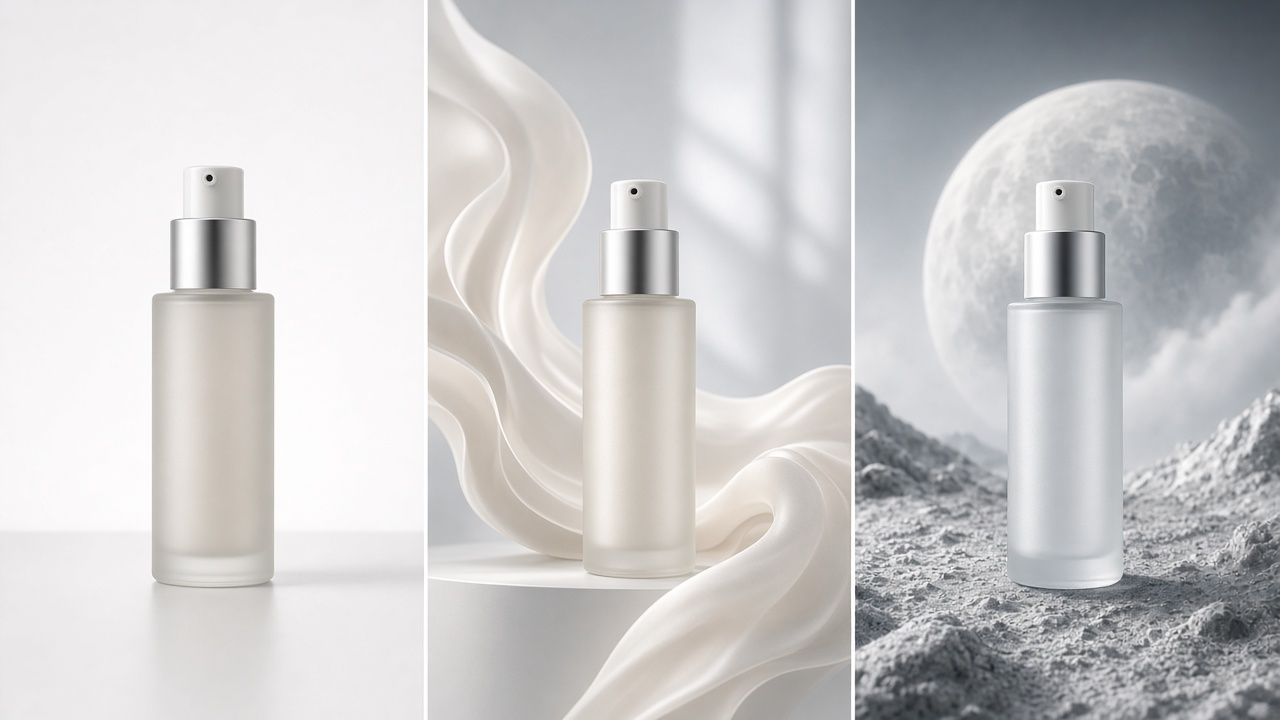
Imagine a real perfume bottle floating above a moonlit landscape. Nobody reasonably expects the perfume to levitate. The landscape is a creative setting. Now imagine an AI image that subtly changes the bottle from 30 ml to 100 ml, adds a premium ingredient badge the product does not have, or shows an application result that never occurred. The same technology has crossed from imaginative staging into a potentially misleading product claim.

| Scenario | Usually appropriate when accurate and transparent | Potential problem |
|---|---|---|
| Beauty campaign | Place the real cosmetic product in a clearly fantastical environment | Invent a clinically proven claim or fabricated before-and-after result |
| Fashion lookbook | Show a real garment styled in different plausible scenes | Change cut, fit, fabric, or color so buyers expect the wrong item |
| Home furnishings | Visualize a sofa in a designed room with its actual dimensions and finish | Make a small sofa look much larger or conceal construction details |
| Customer endorsement | Use an authorized real testimonial with accurate attribution | Invent a happy buyer, fake review, or celebrity endorsement |
| Travel promotion | Create a conceptual illustration clearly identified as such | Pass a fabricated hotel room or destination photo off as a real property |
Context and audience expectations matter; these examples are editorial guidance, not legal determinations.
That distinction collapses when the product itself changes. Atmosphere can be invented; size, formula claims, packaging, shade, and performance evidence cannot. Compare a faithful reference against a generation that quietly upgrades the bottle—and the promise. For a fuller QC list, see common AI product photography mistakes.

Do AI-generated ads need a disclosure label?
There is no universally correct answer for every creative step. A tool that helps brainstorm headlines is not the same as a synthetic presenter speaking as if they were a real customer. Disclosure is especially important when someone might mistake a generated person, event, performance result, or product demonstration for authentic evidence.
In its January 2026 report, IAB found that 73% of surveyed Gen Z and Millennial consumers said knowing an ad was created with AI would either increase or not change their purchase likelihood. That finding does not prove a disclosure label always improves performance, but it challenges the assumption that disclosure inevitably damages it. IAB subsequently updated its AI Transparency and Disclosure Framework in August 2026, emphasizing context and material risk of deception rather than indiscriminate labeling of every AI touchpoint. Sources: IAB, The AI Ad Gap Widens and IAB AI Transparency and Disclosure Framework
Useful disclosure language
“AI-generated campaign illustration. Product shown is real.”
“Concept image created with AI; final product details may differ.”
“Virtual presenter created with AI.”
“AI-assisted visual concept. Product photography and specifications verified by our team.”
Choose wording that accurately describes the specific asset. A disclosure must not become an excuse for false advertising. In the US, the FTC expects advertising claims and endorsements to be truthful and substantiated; AI does not exempt a business from those standards. See the FTC Advertising FAQs for small business.
Seven practical rules for honest AI advertising
A pre-publication review for brands and agencies
1. Verify the product
Compare every final image or video against the real product. Check dimensions, color, material, packaging, labels, accessories, and depicted functions. If a meaningful detail changed, fix it or clearly qualify the concept.
2. Separate atmosphere from evidence
A dramatic setting can be fictional. A performance demonstration, medical effect, durability claim, or measurable outcome needs real support.
3. Never invent customer experiences
Do not fabricate reviews, testimonials, case studies, endorsements, or people presented as real purchasers.
4. Treat synthetic people carefully
Make it clear when a virtual presenter or generated model could be mistaken for a real person with authentic experiences. Obtain permission when a real identity or likeness is involved.
5. Disclose material AI involvement
Use plain language where AI origin matters to the viewer’s interpretation. Consider the channel, product category, and whether a realistic scene looks documentary or illustrative.
6. Keep humans accountable
Assign a reviewer who owns factual accuracy, creative quality, brand suitability, and compliance before campaign publication.
7. Measure trust, not only clicks
Monitor complaints, returns, customer service questions, perceived authenticity, and creative comprehension along with conversion rates.
How ecommerce brands can use AI without compromising product trust
For ecommerce, a sensible starting point is a real reference asset: an approved product photo, verified specs, and clear brand guidelines. From there, a creative team can explore seasonal compositions, lifestyle contexts, campaign concepts, styling directions, and video treatments. The reference anchors the work; experimentation happens around it. Related reading: how to build trust with product photos.
The most valuable workflow is not “generate something plausible and publish.” It is “generate several promising directions, then verify and refine.” For fashion, that might mean preserving garment construction and fit while changing models or environments responsibly. For skincare, it might mean producing a cinematic bottle campaign while avoiding fabricated application results. For furniture, it might mean exploring room styling without altering proportions or finish.

Our position at GenImagePro: create freely, represent honestly
GenImagePro is a visual creation platform for AI images and videos, creative ideation, and business content workflows. We believe these tools should help people explore possibilities, develop stronger ideas, and produce high-quality visual campaigns—not make it easier to mislead customers.
We support imaginative concepts, responsible disclosure, accurate product representation, respect for real identities, and human creative judgment. A fictional campaign environment can be inspiring. A fabricated product promise is not. We believe brands should be able to move quickly and still stand behind what they publish.
These are principles for how we believe AI visuals should be used. They are not a claim that every generated output is automatically verified or that using a creative platform guarantees legal compliance. The publisher remains responsible for checking and approving its advertising.
The future of AI ads depends on more than the technology
The most successful visual campaign is not necessarily the one that hides its production process. It is the one that connects an original idea to a believable brand promise. AI can extend the range of stories marketers tell, but it cannot replace the responsibility to tell the truth about what customers are buying.
US research suggests consumers are skeptical, not uniformly opposed. They distinguish between ways AI is used; they sometimes struggle to identify AI-origin advertising; and they still care about the quality and authenticity of the work. Brands that understand all three findings can build more ambitious creative systems without treating trust as an afterthought.
Frequently asked questions about AI ads
Why do people hate AI ads?
Many people feel deceived when an AI ad promises something the product cannot deliver. Others object to synthetic people or voices replacing real ones, repetitive aesthetics, low-effort creative, and the loss of a human perspective. In a 2026 Bentley University–Gallup survey, 49% of US adults viewed businesses using AI to create ads negatively.
Do Americans dislike every use of AI in marketing?
No. In a 2026 Bentley University–Gallup survey, 75% said clearly disclosed AI assistance for brainstorming or early drafts was acceptable, compared with 53% for final ad text, imagery, or video.
Can consumers tell whether an advertisement was generated with AI?
Not reliably in every case. Controlled research by Huang and Katona found participants could not consistently separate AI-generated from human-made ad imagery. That finding should not be generalized to every format or every audience.
Are AI-generated ads effective?
They can be, but results depend on creative quality, audience, context, and trust. Detection and perception studies do not establish one universal conversion rate for AI ads.
Should brands disclose AI-generated ads?
Yes, when the AI content could be mistaken for real people, events, evidence, or product results. In a 2026 IAB study, 73% of surveyed Gen Z and Millennial consumers said knowing an ad was made with AI would raise or not change their purchase likelihood. A disclosure never makes a false claim acceptable.
Is AI product photography deceptive?
Not inherently. Creating a new artistic setting around a real, faithfully represented product is different from inventing features, changing materials, or showing results that do not exist.
Can I use AI models in fashion campaigns?
AI-generated models can be used in creative concepts, but brands should consider clear identification, permission for any real likeness, representation and body-image concerns, and accuracy of the garments shown.
What is GenImagePro’s position on ethical AI advertising?
Our position is to expand creative possibilities while keeping product claims accurate, respecting identities, disclosing AI when material, and retaining human review and accountability.
Research and further reading
Primary research and guidance